


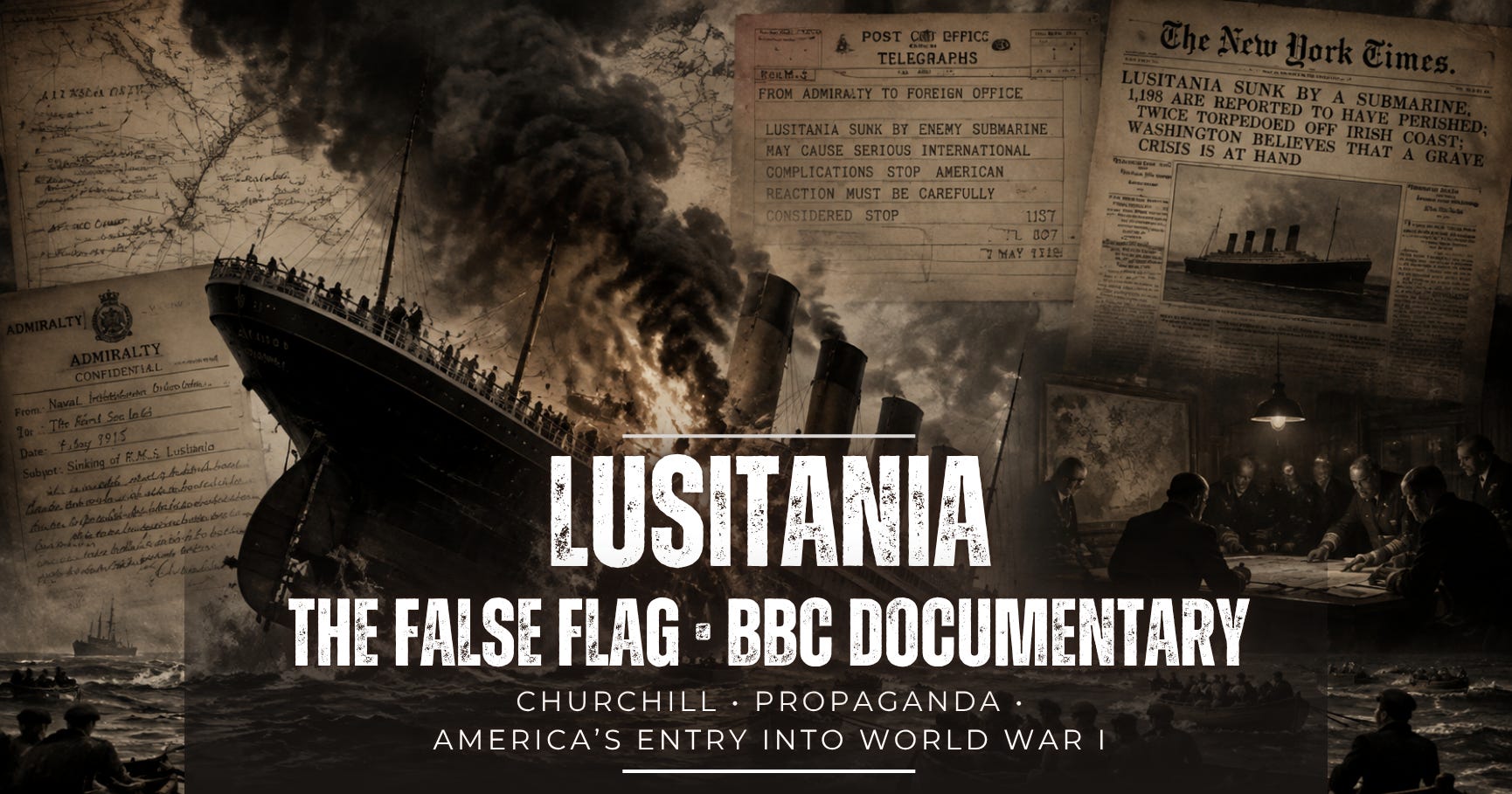
The RMS Lusitania remains one of the most controversial events of World War I.
On May 7, 1915, the British ocean liner was torpedoed by German submarine U-20 off the coast of Ireland, killing nearly 1,200 people, including 128 Americans.
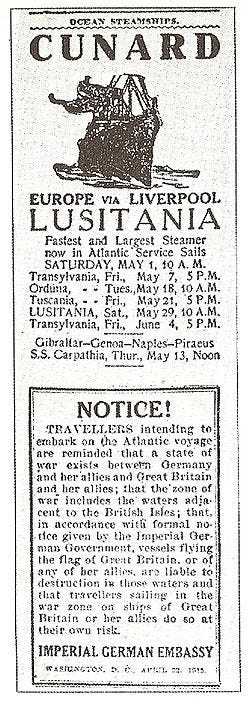
Before the Lusitania sailed, the Imperial German Embassy published a public warning in American newspapers directly beside Lusitania travel advertisements, warning passengers that the waters around the British Isles were a war zone.
The warning was printed. The voyage continued. Six days later, the Lusitania was at the center of one of the most consequential political crises of World War I.
But beyond the tragedy itself was another battle:
The battle for public opinion.
A BBC documentary examining the Lusitania raises one of the most important questions of World War I:
Was the sinking simply a wartime disaster — or did British officials view a potential American casualty event as an opportunity to accelerate U.S. intervention?
The documentary highlights Winston Churchill’s role as First Lord of the Admiralty and presents his own words:
“It is most important to attract neutral shipping to our shores, in the hope especially of embroiling the United States with Germany. If someone gets into trouble, no bad things…”
The documentary then shows the reaction of a British naval intelligence officer after Churchill was informed that a smaller vessel had been torpedoed:
“Meaning a few Americans casualties might hasten their entry into the war.”
The documentary presents this exchange as evidence of a strategy where an American casualty event could create political pressure for U.S. involvement in World War I.
The Lusitania controversy also connects to the larger financial and political architecture of the era.
Before World War I, Churchill developed relationships within Britain’s elite political and financial circles, including Nathaniel “Natty” Rothschild. The Rothschild banking network was deeply embedded in the financial architecture of European power, influencing how governments raised money, sustained wars, and expanded political influence through access to credit and capital.
As Dame Hannah Rothschild later stated, “No king or government goes to war without the support of the Rothschild family,” highlighting the central role that financial networks played in enabling — or constraining — the decisions of governments during times of war.
This documentary is a visual companion to my larger investigation into:
• The Rothschild financial network
• The financing of modern warfare
• The Balfour Declaration
• Churchill’s political rise
• World War I diplomacy
• The systems of power that shaped the modern world
Read the full investigation:

SUPPORT NOTE
The Phantom Directive remains free by principle.
Public awareness should never be gated.
But real investigative journalism takes resources:
the research, the document forensics, the verification work, the mapping, and the fight against coordinated suppression that follows every one of these reports.
If you can become a paid subscriber, it directly strengthens this project.
If you prefer a one-time gesture, you can buy me a coffee:
buymeacoffee.com/phantompain1984
If neither is possible, sharing this investigation is still an act of resistance.
Either way, participation matters.
The system depends on silence; this project depends on refusal.
— Phantom Pain
USS Liberty: The Israeli Attack America Was Ordered to Forget

“Phantom Pain, you’re spot on. LBJ set us up to sink us fast, blaming Nasser for the attack. Liberty not sinking — by the grace of our Savior Jesus Christ — saved millions of lives.”
Israel and the Birth of Modern State Terrorism

To understand the operations that reshaped the Middle East — and would one day touch America itself — you must begin with the men in this photograph.
JFK: “Hitler Will Emerge… As One Of The Most Significant Figures Who Ever Lived”

“A real and final catastrophe… the terrorist organizations built up from our own ranks.” — Albert Einstein, April 10, 1948 letter.
Epstein’s “Lolita Express” Was Never a Mystery — The Elite Knew Exactly What the Name Meant

“Lolita Express” is a sexual reference, taken directly from Nabokov’s novel Lolita, which centers on the sexual exploitation of a 12-year-old girl by an older man.


