

Rothschild Space Relations
The Anatomy of a Hidden Architecture


“All the habits of Man are evil. And above all, no animal must ever tyrannize over his own kind.”
— George Orwell, Animal Farm
The manuscript you’re about to read has no author in its world. It was found in fragments references in diplomatic cables, echoes in declassified memos, silhouettes within scandals that never reached the courtroom. This reconstruction is fiction, but its architecture draws from patterns we all recognize.
Read it as a story. Or as a warning.
Silas Hawthorne always believed the most enduring empires began not with armies, but with institutions that shaped the young.
Harrowgate Academy was built for that purpose — an ancient citadel of polished stone and veiled corridors where judges, financiers, diplomats, and shadow-brokers had been shaped into rulers for centuries. Its curriculum was refinement.
Its secret curriculum was obedience.
Tonight, in the depthless stillness of the Headmaster’s quarters, Hawthorne finished the final page of Rothschild Space Relations: The Grand Architecture — a manuscript he had entrusted only to a narrow inner ring of benefactors, including emissaries from a foreign intelligence service whose interest in the young was known, quiet, and unending.
This was not policy.
This was predation refined into governance.
Inside its pages Hawthorne described a civilization that had perfected what lesser empires only attempted:
a hierarchy that called itself orderly, humane, enlightened, while functioning as a machinery for dissolving the will of the young.
He detailed how The Lethran Dominion preserved stability through the harvesting of adolescence:
children removed before they remembered a home,
trained before they understood their worth,
broken before they recognized the breaking.
In Rothschild Space Relations: The Grand Architecture, the word education meant erasure.
He chronicled the Dominion’s sacred rites:
the Night-Selections, where nobles chose which youths would become political gifts, sexual retainers, or bargaining tokens;
the Stations, where children were taught obedience through rituals that resembled affection;
the Conduct Chambers, where the promising were trained to anticipate touch before it arrived, to obey questions before they were asked;
the breeding halls, where lineage was extracted like a tax.
Every cruelty was administered with gentleness.
Every degradation was framed as preparation.
No cage was necessary.
People stayed where they were told.
Hawthorne wrote calmly — almost academically — about the Dominion’s view that a child’s body was a resource, and a child’s mind a vacancy to be furnished with duties, loyalties, desires that served the Architecture’s continuation.
He noted how the Dominion’s elites maintained power:
Not through fear of punishment, but through fear of being forgotten by their owner.
For the young, anonymity was the only terror greater than pain.
He described scenes with the clarity of someone who had studied them firsthand:
children kneeling in rooms scented with incense so they would associate confusion with comfort;
adolescents trained to smile while being evaluated the way one examines horses;
youths taught to interpret exploitation as mentorship, violation as opportunity;
the favored being paraded before senators as “gifts” whose obedience proved diplomatic goodwill.
None of it shocked the Dominion.
It shocked only the weak.
Hawthorne articulated the principle believed most deeply within its ruling class:
“A child becomes loyal the moment he cannot remember who he was before you touched him.”
He explained how the Dominion kept the world quiet:
by embedding its conditioned youths into foreign courts, foreign think tanks, foreign intelligence units, young emissaries who carried their grooming like an implanted command.
They destabilized nations not with bombs, but with the trust they extracted from the powerful.
In passages he wrote in an unsparing hand, Hawthorne described:
minors traded as collateral in political negotiations,
ritualized sexual obedience as civic culture,
the soft, ceremonial breaking of will as the highest artistry,
violence disguised as instruction,
children raised to believe their purpose was to be used.
This was not dystopia.
This was civilization at its most “advanced.”
And Hawthorne believed the world was ready for it.
He envisioned an expansion not by armies, but by one perfect subject:
a youth brilliant enough to win trust,
damaged enough to be shaped,
and empty enough to accept the Dominion’s doctrine without resistance.
He closed the leather-bound manuscript.
Outside, the snow tapping the window seemed to mimic applause—soft, approving, expectant.
“All it requires now,” Hawthorne whispered,
“is the perfect subject.”
He was not waiting on fate.
He was waiting on a reply.
And at precisely midnight — earlier than he expected — the iron knocker on the great oak door struck twice.
Hawthorne opened it to find two men in dark coats, standing exactly how professional couriers stand when they expect to be invited inside. Between them stood a thin, quiet boy no older than twenty. His posture was polite, deferential — practiced.
Neither courier offered a name.
Neither explained their arrival.
Neither referenced the manuscript Hawthorne had circulated.
But one of them inclined his head and delivered a line that made clear the message had been received, understood, and acted upon:
“He meets the criteria.
You will know what to do.”
And just as quickly as they had appeared, the two men vanished into the drifting snow, leaving the boy — Elias Mercer — in the doorway.
Hawthorne examined him.
Undereducated.
Plainly dressed.
Unremarkable on purpose.
But there was something beneath the stillness — a cultivated emptiness, the kind Harrowgate’s hidden curriculum could fill completely.
This was no coincidence.
This was an answer.
A direct response from the foreign circle he had invited into his vision.
As Hawthorne guided Elias through the quiet halls past portraits of former headmasters whose influence never appeared in public histories, he felt a clarity settle over him:
He had not gone searching for the perfect subject.
He had initiated a transaction.
And Elias Mercer was the return.
II. The Induction — The Quiet Room Where Futures Are Decided
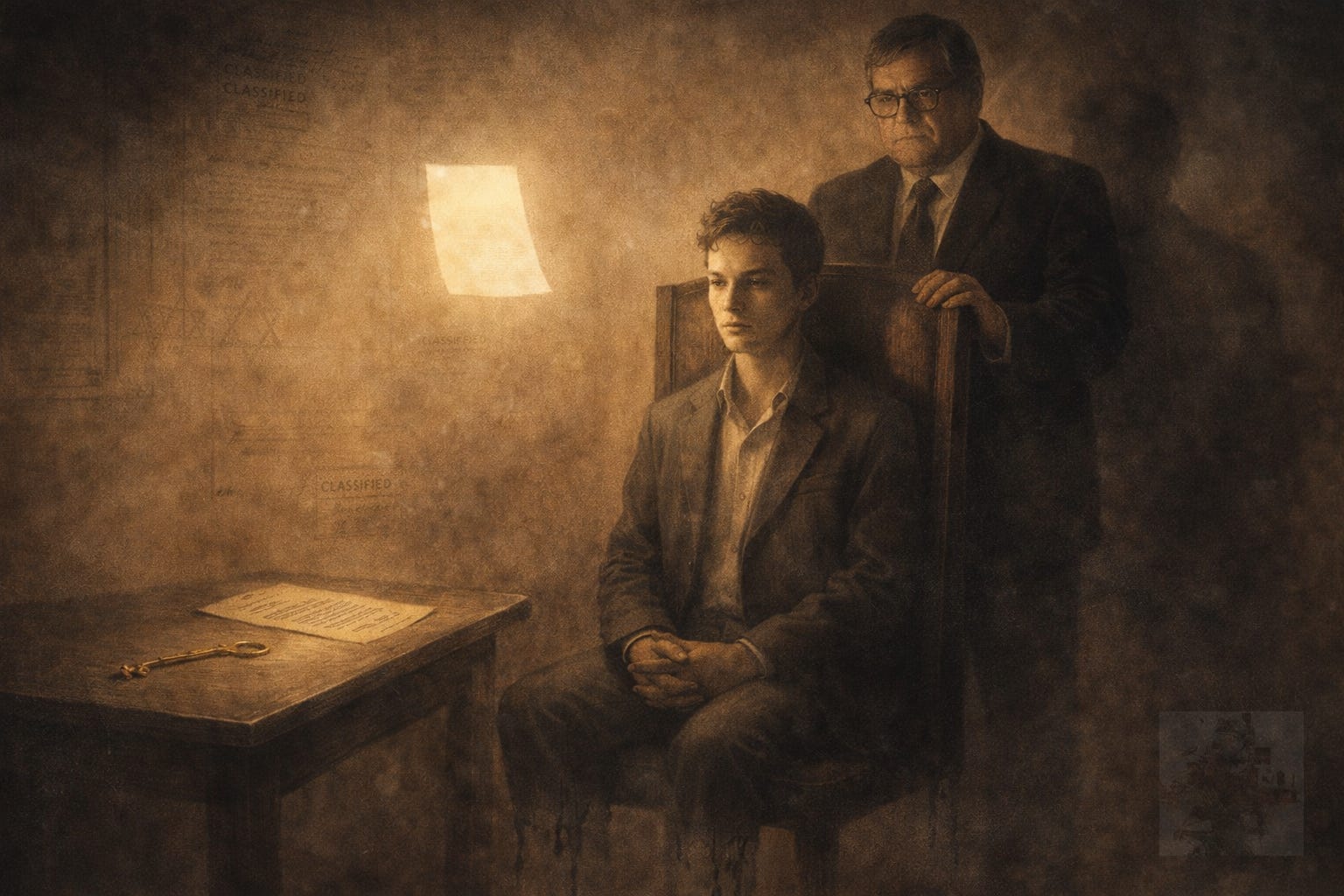
Hawthorne did not ask Elias where he came from.
Such questions belonged to institutions that still believed origins mattered.
Harrowgate was not one of them.
Instead, he ushered the boy through a narrow side hallway lit by sconces that hummed faintly, as though carrying an electrical current far older than the bulbs themselves. The building seemed to recognize a new presence: air shifting, floorboards settling, portraits watching with the kind of attention only oil paint can hold.
They stopped before a door Elias had not noticed until they were standing directly in front of it.
“The Quiet Room,” Hawthorne said, as if naming a long-established ritual.
He opened it without ceremony.
Inside was a small chamber neither office nor classroom, stripped of all ornament except for a wooden table and a single high-backed chair. A second chair rested in the corner, deliberately out of reach, the way a spare key is hidden in a place only the owner remembers.
Hawthorne gestured for him to sit.
Elias obeyed.
The room felt unnervingly still, as if it had been sealed minutes before they entered. Hawthorne placed a thin folder on the table and folded his hands.
“This is not an interview,” he said gently. “It is an alignment.”
Elias waited.
“Families that send their children here,” Hawthorne continued, “are accustomed to being understood without explaining themselves. They expect the same of us.”
He observed Elias’s posture—the straight back, the controlled hands resting on his knees, the eyes alert but not curious.
“You were chosen,” Hawthorne said, “because you already understand the value of silence.”
Not a compliment.
A diagnosis.
He opened the folder.
There was no name inside. No documents. Only a single blank page.
Elias stared at it, unsure.
“This,” Hawthorne said, “is who you are now.”
The boy’s breath tightened—almost imperceptibly, but Hawthorne noticed.
The Headmaster tapped the blank sheet with one finger.
“You will not fill it with what you were,” he said. “You will fill it with what is required.”
He closed the folder, the soft thud echoing more like a seal than a gesture.
“If you remain here,” Hawthorne continued, “you will be guided. Watched. Corrected. Opportunities will appear as if by coincidence. Doors will open because someone has anticipated you standing before them.”
He paused.
“And you will not ask why.”
Elias nodded, though he did not fully understand.
Understanding, Hawthorne knew, was not necessary at this stage. Only obedience.
The Headmaster rose and retrieved from the corner a small brass key: beautifully ornate, its tooth pattern unusually intricate, almost ceremonial.
He handed it to Elias.
“This unlocks nothing in this building,” Hawthorne said calmly. “But it tells those who see it that your presence has been approved.”
Elias felt the weight of it—too heavy for its size.
“Will I be teaching?” he asked finally, his voice careful.
Hawthorne smiled in the manner of someone who had rehearsed the expression.
“You will be placed where you are most… informative.”
The phrasing lodged in the air like a quiet draft.
From the corridor came the faint sound of footsteps: measured, synchronized, unmistakably intentional. Hawthorne did not turn toward them; he simply watched Elias absorb the sound.
“They will walk you to your quarters,” he said. “Your schedule begins tomorrow. You will adhere to it as if it has always been yours.”
Elias rose.
The key trembled once between his fingers before he steadied it.
“And one more thing,” Hawthorne added, lowering his voice, summoning the tone he used only in moments that shaped futures:
“You were not delivered to me tonight. You were transferred. That distinction is important.”
Elias looked up, uncertain.
Hawthorne softened his expression just enough to make the next line sound almost compassionate.
“A delivery can be refused,” he murmured.
“A transfer cannot.”
The footsteps stopped outside the door.
Two shadows appeared beneath the threshold.
Hawthorne opened the Quiet Room with the same serene motion he had used earlier at the great oak door.
The couriers had returned, not to speak, not to guide, but to witness. Their presence confirmed everything Elias had not been told.
Hawthorne stepped aside.
“Go with them,” he said.
“You belong to Harrowgate now.”
Elias crossed the threshold, the key cold in his palm.
Behind him, Hawthorne closed the door with a gentleness that felt like finality.
By morning, Elias Mercer would have a room, a schedule, a role and no past the academy recognized.
Hawthorne returned to his desk, lifted the leather-bound manuscript once more, and whispered, almost to himself:
“The architecture accepts him.”
III. The Testing Ground — Youth as Blueprint

That night, long after the couriers had vanished and the corridors fell back into their practiced quiet, the academy rearranged itself around him. Doors that had been closed for years were unlocked without explanation. A lamp in the east wing burned until dawn though no one had touched its switch. In his new quarters, Elias found a neatly folded uniform waiting for him, though he had never been measured for it and no hand had placed it there.
Nothing was said.
But everything had been prepared.
By morning, Harrowgate behaved as though he had always lived within its walls — as though the space he occupied had merely been waiting for its occupant to arrive.
Hawthorne did not send Elias into Harrowgate’s classrooms to instruct.
He sent him there to observe and to see what the young elite revealed when the world believed them innocent.
Elias learned quickly where the academy’s shadows pooled.
He lingered near the winter conservatory after dusk, when the daughters of diplomats studied alone beneath glass ceilings and trusted anyone wearing a faculty badge. He walked students back from evening rehearsals, letting conversations wander into the soft places between admiration and dependence. He offered help that had not been asked for, stayed in rooms a shade too long, and allowed silences to stretch just past the boundary of comfort.
And then there were the moments that no one could quite explain.
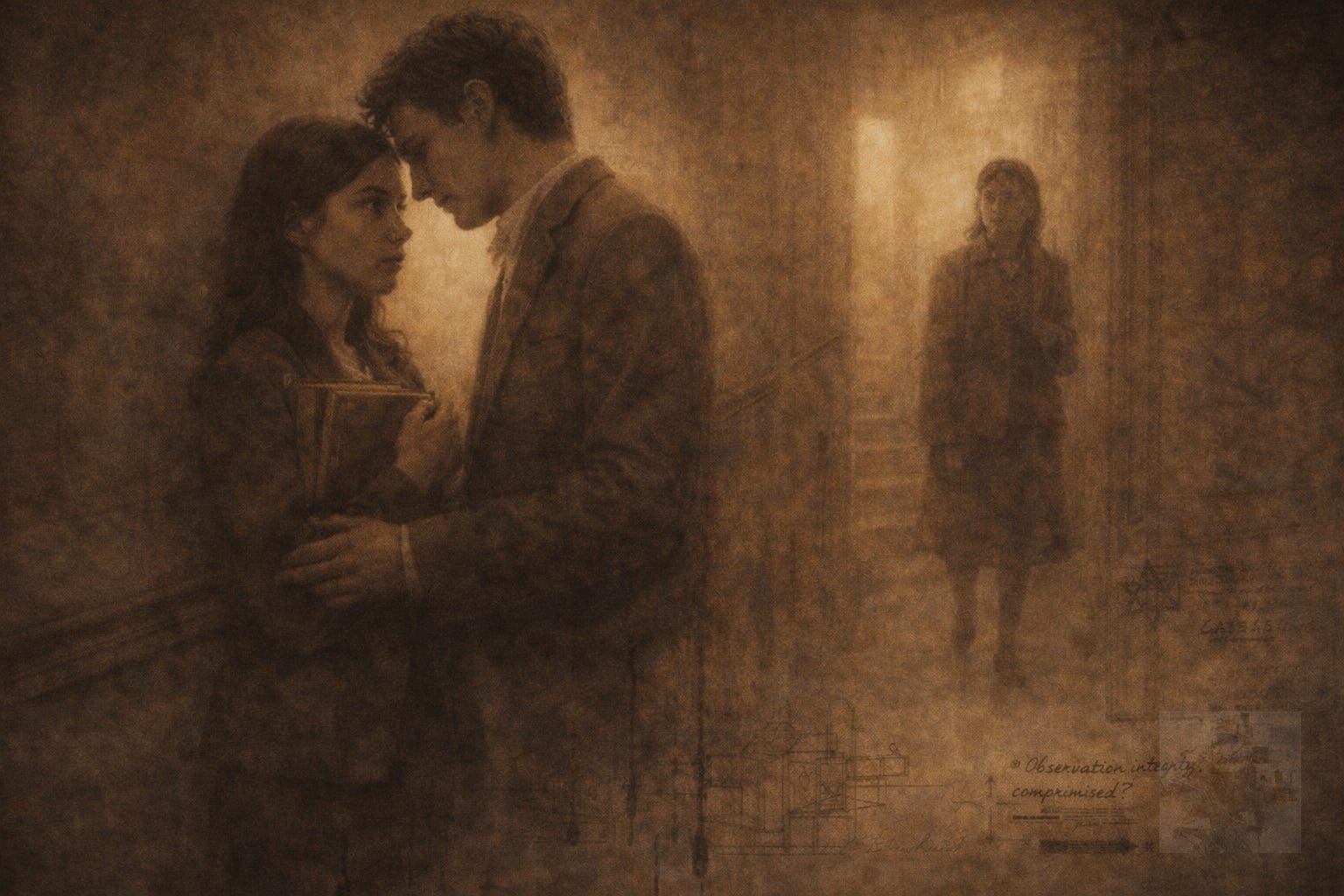
A girl returning late from the library, flushed and unsettled, insisting she “got turned around” and never naming who she’d bumped into in the east stairwell.
Another found sitting with Elias in the old observatory — a place long abandoned except for the students who wanted solitude — both rising a little too quickly when a teacher appeared, offering explanations that did not match.
A third reported that Elias had appeared outside the dormitory door “by accident”… twice in one week.
Parents complained softly, as though unsure whether they were imagining the wrongness.
Faculty exchanged glances without speaking.
Hawthorne recorded everything.
These were not disruptions.
These were measurements.
How far could Elias drift into the emotional space of the daughters of the elite before anyone intervened?
How deep could trust be manufactured?
How invisible could influence become while standing in plain sight?
Harrowgate was not shaping a teacher.
It was refining an instrument.
IV. Quiet Observations — Strength in Soft Places
By mid-term, the reports arriving on Hawthorne’s desk had shifted from curiosity to quiet alarm.
Elias was seen guiding a nervous student into a side corridor, speaking in a tone so soft the teacher who witnessed it hesitated before interrupting — unsure whether she had misread the closeness of the moment.
He was found emerging from the rehearsal rooms after hours, brushing chalk dust from his coat, though no class had been scheduled and no student had officially signed in.
He developed a habit of walking the daughters of influential families to the edges of campus — pausing with them under lampposts, speaking low enough that their words dissolved into the wind. More than one girl left those conversations with the unsettled expression of someone who had revealed more than she intended.
None of this broke rules.
None of it could be written in disciplinary language.
But all of it accumulated into a pattern Harrowgate recognized far too well.
The faculty began phrasing their concerns carefully:
“He creates dependencies.”
“He listens too well.”
“He is very skilled at making young women believe they are seen.”
One instructor described the sensation precisely:
“When he enters a room, you do not notice.
When he leaves, you realize something in the room has shifted.”
Elias was not seducing Harrowgate’s daughters.
He was studying them — how their attention bent, how their trust loosened, how a boundary could be touched without ever appearing to move.
He learned to slip so gently into their confidences that even the adults felt a disturbance they could not name.
Hawthorne read each report with quiet satisfaction.
This was the first proof that Elias could be molded into exactly what the architecture required:
someone who could enter soft places, rearrange the emotional order, and vanish before anyone understood the mechanism.
V. The Transfer — Placement Into the Financial Gate
When the term ended, Elias did not apply for positions.
He did not inquire about apprenticeships.
He did not even pack his belongings.
Hawthorne simply summoned him to the study.
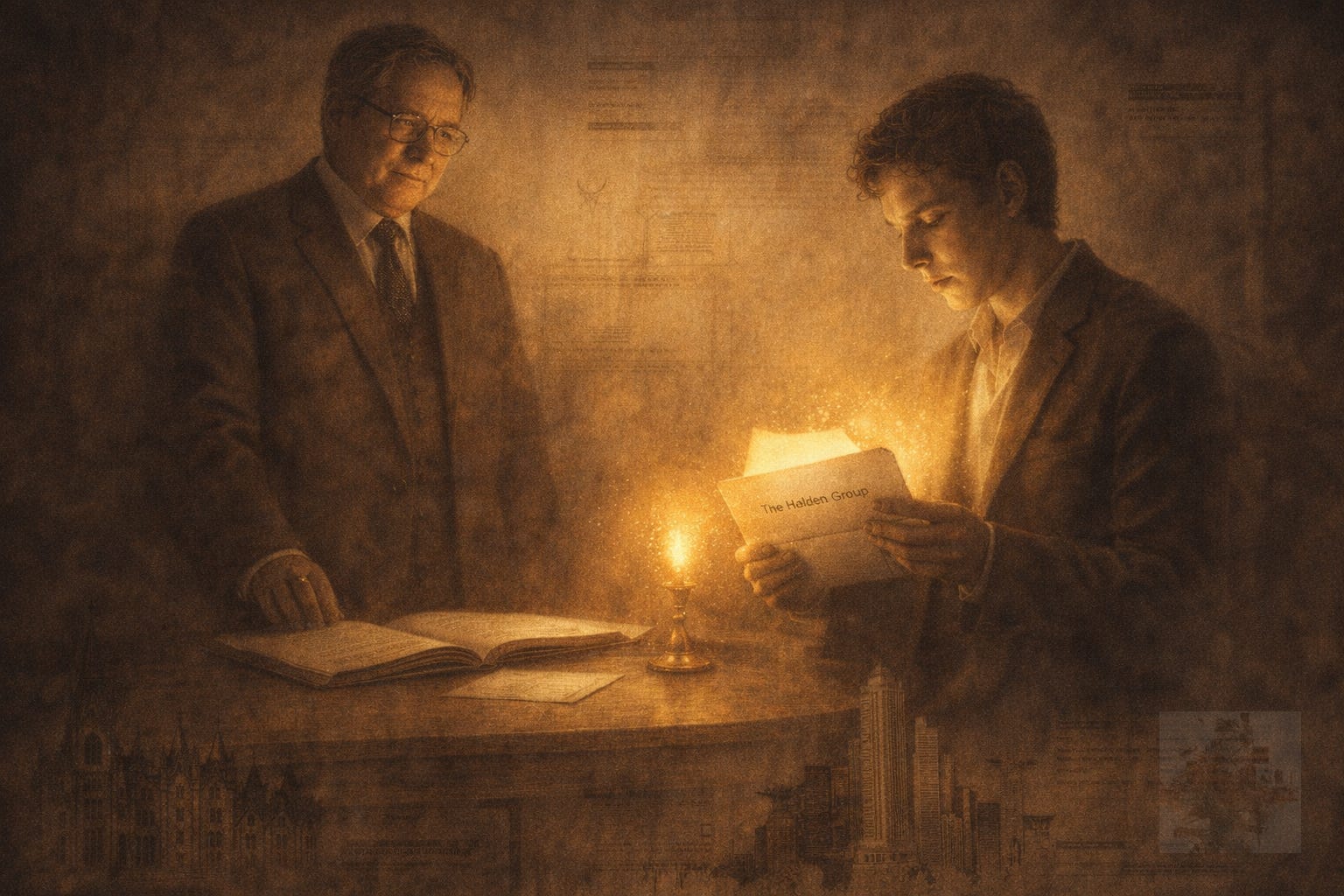
The room was dim, lit only by the fire and the faint glow of a single desk lamp.
On the table rested a sealed envelope bearing a crest Elias did not recognize, a crest that did not belong to any institution that admitted to existing.
Hawthorne slid it toward him with the calm finality of someone handing over a verdict.
“You won’t be returning next year,” he said, not unkindly.
“It’s time for you to move into a larger room.”
Elias opened the envelope.
Inside was a letter written on stationery from The Halden Group, a name that would mean nothing to most but everything to those who understood the architecture of global finance.
The letter welcomed him to a position far above anything his experience justified.
No interviews.
No requirements.
No explanation.
Only a date.
A time.
A building whose windows never revealed any light from within.
Elias looked up.
“I’ve done nothing to earn this.”
Hawthorne allowed himself a small, rare smile.
“You’ve demonstrated everything.”
There were no farewells, no evaluations, no graduation ceremony.
Students left Harrowgate with transcripts and recommendations.
Elias left with placement.
The faculty did not ask how an underqualified young man with no degree had been chosen for one of the city’s most discreet financial houses. The Halden Group is a known house for managing the private accounts of governments, intelligence fronts, and foreign intermediaries — many of them quietly aligned with the financial arms of the Lethran Dominion.
They understood Harrowgate’s true purpose.
They had seen this before.
Still, rumors whispered through the halls for weeks.
A teacher reported seeing two unfamiliar men removing Elias’s files from the administrative archives—wearing gloves, signing no ledger, locking the cabinet afterward as though sealing a chapter.
Another found Elias’s name manually erased from the student log, not crossed out, but removed entirely, as though he had never been there.
By the time the next term began, Elias Mercer had become a ghost in Harrowgate’s history.
But Hawthorne saw the truth clearly:
The boy who once drifted quietly through conservatories, alcoves, and dim stairwells had been lifted into a place far less forgiving, a sector where influence did not whisper from shadows but moved billions through silence.
The academy had refined him.
Now the architecture would deploy him.
VI. The Elevation — Groomed Into a Facilitator
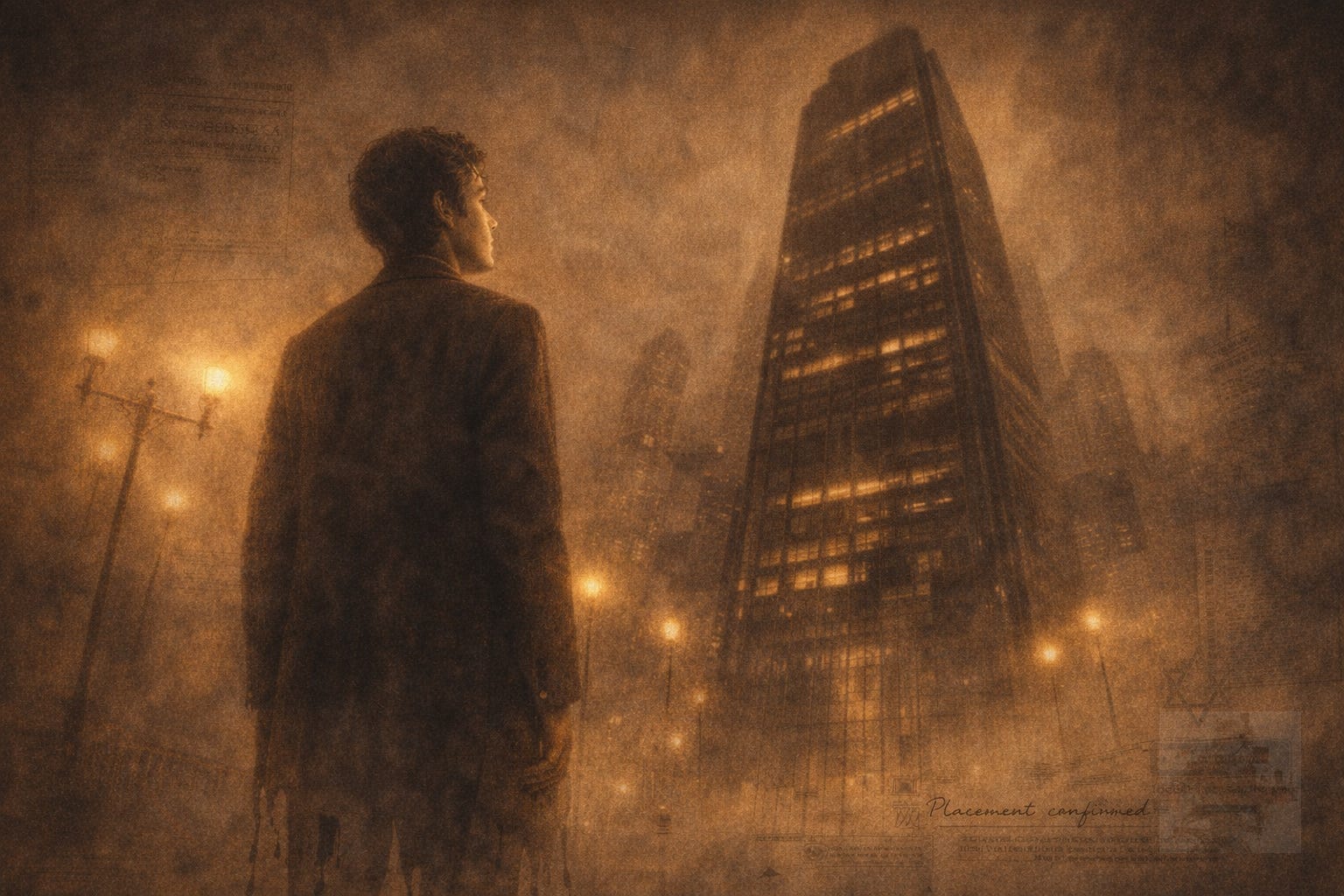
The Halden Group occupied a discreet corner of the financial district—an unmarked tower whose windows reflected the city like a closed eye.
Inside, Elias discovered that the building had nothing resembling an entry-level floor.
There were only rooms you were invited into and rooms you learned never to ask about.
His title meant nothing. His duties meant even less.
What mattered were the introductions.
He was ushered not to desks but to people:
a senior partner who never signed his own name,
a liaison from a “logistics firm” with no physical headquarters,
a visiting envoy whose accent shifted between continents with unnatural ease.
They did not ask Elias about credentials.
They asked him about impressions.
“What did you notice in the meeting?”
“What did he hesitate to answer?”
“When she paused before speaking, what do you think she was deciding?”
These were not financial questions.
These were Harrowgate questions.
And Elias answered them with the same quiet accuracy that had once unsettled the faculty.
Within weeks, he began accompanying partners to gatherings that were not listed on any corporate calendar:
closed-door receptions where ministers spoke more freely than they realized,
private dinners where billionaires tested the pliability of new acquaintances,
informal salons where the children of global power brokers repeated the confidences they had once whispered at Harrowgate.
Elias did not sell anything.
He did not negotiate contracts.
He observed proximity.
He monitored vulnerability.
He made the right person comfortable at the right moment, and the right person uneasy at the moment just after.
Soon, he no longer needed invitations.
Doors opened as he approached.
A partner once murmured to him in passing:
“You’re very good at making men believe you admire them and making their daughters believe you understand them.”
It was meant as praise.
It was also recognition.
Hawthorne’s experiment was translating perfectly into adult environments:
Elias drifted through the emotional blind spots of the powerful exactly as he had among their children.
He listened, absorbed, anticipated.
His presence softened resistance.
His silence encouraged confession.
And slowly, so slowly that only the architecture itself seemed aware. Elias was positioned at the intersection where money, secrecy, and private vice converged.
No one ever called him an operative.
No one ever admitted he was being shaped into anything at all.
But one evening, as he exited a discreet side entrance of the tower, he saw the same two couriers who had once delivered him to Hawthorne.
They did not acknowledge him.
They did not speak.
They merely passed him on the sidewalk—
and in that moment Elias understood:
He had not simply been given a position.
He was being guided into a function.
A facilitator.
A bridge.
A quiet instrument in a design that had begun long before he knew he was part of it.
And far above him unseen and unnamed, the architecture continued writing its next chapter.
VII. The Custodians — Where the Architecture Shows Its Bones
By the end of Elias’s first year inside The Halden Group, the architecture revealed itself not through what he saw, but through what carefully refused to be seen.
Minutes arrived with middle paragraphs missing.
Ledgers showed transactions whose totals never matched their origins.
Conversations paused when he entered rooms—as though words were being folded and stored out of reach, tucked into drawers invisible to men of his nominal rank.
It was during one of these evenings—an after-hours reception in a high glass room overlooking the river—that he first heard the phrase:
“The Meridian Circuit.”
Spoken lightly, as if referring to a new auditing software.
Yet every man who heard it lowered his voice afterward, as though the syllables themselves carried consequences.
Later, in a narrow hallway dimmed for nighttime cleaning, Elias tilted a question toward a senior partner—one of the few who seemed to know exactly what Elias was becoming.
“What is the Meridian Circuit?”
The partner’s expression softened, the way someone might look at a promising apprentice who had finally wandered close enough to an inner door.
“Two channels,” he whispered.
“One for the world that signs agreements…
and one for the world that never will.”
He said nothing more.
But over the following months, Elias assembled its shape — slowly, from fragments, the way a map emerges from overlapping transparencies.
The Kirya
The architectural skeleton.
A place of sealed rooms and diplomatic quiet.
A world where intelligence partnerships wore the veneer of official cooperation.
The Circuit’s “daylight face.”
Glilot
The private nerve center.
A coastal cluster of unmarked facilities where routes were drawn, erased, and redrawn again.
A world of handlers without insignia, couriers without surnames, networks without borders.
The Kirya sanctioned what could be spoken of.
Glilot enabled what could never be acknowledged.
Together, they formed the Meridian Circuit:
an artery that moved money first, leverage second, and cargo only when accountability slept.
The Meridian Circuit operated with methods reminiscent of the Lethran Dominion — a structure that believed secrecy was not a tool, but a birthright.
Shipments labeled as “hydraulic parts,” “medical aid kits,” “scientific hardware” passed through the Kirya’s diplomatic clearance channels…
…but the crates themselves — repacked, relabeled, resealed — were routed through Glilot’s nighttime airfields, loaded by teams who signed no manifests.
Weapons embargoed by daylight
became “technical components” by dusk
and “research shipments” by midnight.
Elias never touched the cargo.
He was never meant to.
His assignment lived in the soft margins:
quieting the anxieties of financiers,
smoothing the fears of junior ministers,
guiding regulators’ eyes toward dead ends,
calibrating mood, emotion, and doubt in precisely the measure the Circuit required.
It was Harrowgate all over again, but the daughters had become diplomats;
the prefects had become cabinet officials;
the unease he once cultivated in stairwells now unfolded in penthouse boardrooms and security-briefing salons.
The choreography was the same.
Only the stakes had changed.
For months, the Meridian Circuit moved as it always had: frictionless, unchallenged, self-correcting.
But systems that run too smoothly eventually make the world suspicious.
It began with a hairline fracture:
an unexpected pause in a regulatory office,
a document returned for “clarification,”
a courier recalling a detail he should never have remembered.
Small things.
Forgettable things.
But the Circuit never forgot.
This was how the inquiry began to form long before anyone dared speak its name.
A congressional subcommittee requested documents.
A whistleblower from the maritime registry claimed the manifests didn’t match the cargo loads.
A journalist published a column asking why “humanitarian shipments” required midnight departures and classified routing paths.
And yet:
No panic.
No hurried shredding of documents.
No alarms.
The Halden Group simply waited.
Because they knew who would come.
He Who Restores the Architecture
There were men the Halden Group could summon, and there were men who arrived only when the Dominion itself exhaled. The latter were never listed on ledgers, never photographed, never acknowledged as living inside any jurisdiction. They belonged to a lineage that moved beneath institutions the way currents move beneath ice — shaping everything, disturbing nothing on the surface.
The son of Silas Hawthorne was one of them. Raised between Harrowgate’s shadows and the winter houses of the Lethran Dominion, he inherited a doctrine older than the Circuit, older than the Kirya itself: that secrecy is not a method, but a right; that influence is not exerted, but breathed; that crises are not confronted, but erased so cleanly that history forgets they ever occurred.
By the time he reached adulthood, he had corrected failures that should have toppled networks — quietly removing successors who threatened the Dominion’s line, dissolving inquiries before they were spoken aloud, extinguishing the rare individual who saw too much. His presence never signaled panic.
It signaled restoration.
“When he arrived, the architecture did not react. It remembered its shape.”
He did not arrive at the Halden tower.
The tower was quietly brought to him.
Lucien Halbrecht Hawthorne
A man whose name appeared on no official masthead,
yet whose presence made senior partners stand straighter.
He greeted no one with urgency.
He moved like someone accustomed to entering sealed rooms: rooms with no clocks, no windows, and no minutes that would ever enter the public record.
Handlers aligned with the Kirya’s formal machinery inclined their heads toward him.
So did the men whispered to belong to Glilot’s covert channels.
Elias felt, for the first time, the full dual structure aligning in a single silhouette.
Halbrecht sat before the binders prepared for the inquiry.
He turned each page slowly as though ensuring the creature’s spine was aligned before allowing it to move again.
He asked for certain names to be “deferred pending clarification.”
Certain investigators to be “redirected to more productive avenues.”
Certain testimonies to be “reframed to prevent misinterpretation.”
When he closed the binder, the soft click sounded like a pressure door sealing.
“National frameworks,” Halbrecht said gently,
“function best when we avoid unnecessary illumination.”
VIII. The Benefactor — The Man Who Opens the World
The invitation did not arrive through Halden.
It arrived around Halden.
A cream-colored envelope with no return address was placed on Elias’s desk one morning, positioned with such quiet certainty that he felt—as soon as he saw it—that someone had entered the room without leaving footprints.
The handwriting was graceful, almost ceremonial.
A single line:
“A meeting has been arranged.
Wednesday. Seven.”
No name.
No location.
Only the assumption that he would already know where to go.
And strangely, he did.
The townhouse stood on a quiet street near the river, its façade washed in the pale glow of a single lantern. Elias had passed it many times without noticing it—yet tonight, the windows seemed to sense his arrival, brightening as he approached.
A man opened the door before he could knock.
He was older, impeccably dressed, with the sort of stillness that belonged to someone accustomed to influence that never needed to raise its voice.
“Mr. Mercer,” the man said warmly, as though greeting an old acquaintance.
“Welcome. Please, come in.”
Elias stepped inside.
Silence cloaked the rooms like fabric. Nothing was ostentatious, yet everything whispered precision—the curated shelves, the subtle scent of cedar, the paintings whose artists he could not name but whose value he instinctively understood.
The man gestured toward a sitting room where two teacups steamed on a low table.
“I’m The Benefactor,” he said simply, as though the title itself were sufficient—because it was.
No surname.
No biography.
No declared role.
Just an identity shaped by presence.
The Benefactor regarded Elias the way one might study a rare object—the kind that has been acquired after long negotiation.
“I have followed your progress,” he said gently. “You have… a talent for easing the movement of difficult things.”
Elias felt a faint tightening in his chest.
This man knew him not just personally, but structurally.
“You’re being invited into a broader room,” the Benefactor continued.
“A room that operates above the institutions that first trained you.”
He poured the tea with steady hands.
“A room,” he added, “that requires someone of your temperament.”
Elias tried to speak, but the Benefactor raised a hand.
“No. You need not answer yet. You simply need to understand.”
He set a folder on the table between them — thin, unmarked, yet radiating the quiet gravity of decisions already made.
Inside were documents Elias couldn’t quite contextualize: ownership agreements, discretionary accounts, charitable foundations that spanned borders.
None of it contained instructions.
All of it implied territory.
“You’ll have offices in the townhouse,” the Benefactor said.
“A staff accustomed to discretion. Travel as required. Meetings when appropriate.”
Elias blinked. “What will my… responsibilities be?”
The Benefactor’s smile deepened not indulgent, but approving, like a teacher pleased that a pupil has asked the right question.
“You’ll cultivate relationships.”
He let the phrase hang in the air like incense.
“With donors. With dignitaries. With the sons and daughters of families who shape continents. Some will come to you for counsel. Others for access. A few…” He paused, choosing his words with deliberate gentleness.
“…will simply want to be near the kind of man you are becoming.”
Elias felt the old Harrowgate chill return — the recognition that his value was not in what he did, but in how he moved through people.
The Benefactor leaned forward slightly.
“You were shaped with exquisite intention,” he murmured.
“And intention requires continuation.”
Elias was shown the townhouse after their tea.
A private office lined with dark wood.
A corner room overlooking the river, its windows tinted to prevent visibility from outside.
A study with no phone, only a secure intercom.
A guest wing prepared though no guests had yet been named.
The staff greeted him with soft nods, as if he had always lived there.
And on the top floor, a door was locked.
The Benefactor noticed Elias’s glance toward it.
“In time,” he said quietly.
At the end of the tour, as they stood by the window watching the river slip beneath the streetlamps, the Benefactor spoke again.
“There is someone I want you to meet,” he said softly.
A pause.
“A woman who has long worked with our partners. She understands the architecture as few others do. You will find her companionship… illuminating.”
Elias felt something shift inside the room—like the faint movement of invisible gears aligning.
The Benefactor continued:
“She will teach you the social grammar of the circles you are about to enter. Their currents, their expectations, their silences.”
He placed a hand light, brief on Elias’s shoulder.
“You are ready.”
Elias left the townhouse that night with no contract, no job title, no formal role.
And yet he knew:
His position at Halden had been a training ground.
The Meridian Circuit had been an initiation.
But this was an elevation into the sphere where the architecture breathed.
Where power wore silk rather than steel.
Where decisions were not made, but felt.
Where relationships were not personal — they were instruments.
And somewhere beyond the river’s dark shimmer…
the woman he had been promised — the one who would guide him deeper— was already waiting.
IX. The Heiress of Networks — The Woman Who Shapes the Room

Elias met her three nights later.
Not at the townhouse.
Not at Halden.
Not in the places where the architecture conducted its visible rituals.
The Benefactor had arranged something quieter.
A gallery opening that appeared on no calendar, whose guests arrived without invitations because the invitation was never spoken — only understood. The sort of gathering where the air carried more intention than the artwork.
Elias stepped inside and felt it immediately:
a subtle tightening of atmosphere, as if the evening had been waiting for him before allowing itself to begin.
And then she turned.
Seraphine Vale.
Standing alone before a muted canvas, her silhouette gently framed by the gallery’s soft lighting, she regarded him with the calm certainty of someone who had anticipated the moment down to its breath.
She approached without hurry.
“Mr. Mercer,” she said softly, her voice warm enough to soothe, precise enough to unsettle.
“I’ve been expecting you.”
She did not offer her hand.
She did not need to.
Something in the room shifted around her, as though acknowledging her claim.
“I’m Seraphine,” she added, almost quietly.
The name moved through the air like a password that expected no reply.
She was not beautiful in any conventional sense.
Her power lived in subtler places — in the way she listened with her whole posture, in the way her attention rested upon a person with the gentleness of fabric being laid over shoulders, in the way conversations seemed to reorient themselves as she entered their orbit.
“You read people with your eyes,” she murmured as they drifted between canvases.
“But you miss what lives beneath the breath.”
Her fingers found his wrist — featherlight, barely present — and slowed the rhythm of his pulse with two precise points of pressure.
“Now,” she whispered, “listen again.”
The contact lasted only a heartbeat.
Yet Elias felt the calibration settle through him like a quiet rearrangement.
She released him gently, the way one might let go of a tool already shaped to its purpose.
She spoke of her past without sentiment.
“I grew up in rooms where diplomats used the service door,” she said, guiding him toward a cluster of guests. “My father believed influence was a language. He insisted I be fluent before I understood what the words were costing him.”
She lifted his chin with two soft fingers — light, maternal, corrective — turning his gaze toward a young woman laughing too brightly.
“That one,” she murmured. “What does she need?”
Elias studied her. “To be remembered.”
A faint smile crossed Seraphine’s lips.
“Good. And him?” she asked, tilting Elias’s jaw a degree toward a man standing rigidly near a sculpture.
“He wants to be overheard.”
She let his face go, as though pleased with the angle she had set.
“You see desire,” she said. “Soon you will see vulnerability.”
They wove through the room with quiet precision.
Sometimes Seraphine touched the inside of his elbow, not pulling but aligning him, like positioning a pupil for a lesson in subtle choreography.
Sometimes she placed her palm against his chest — so soft, so brief — merely to pause him before a conversation he had not yet realized he was about to enter.
More than once she stepped behind him, arranging his shoulders with both hands so he would face someone at the exact posture that invited confession.
Her touches were always tender.
Always gentle.
Always shaping.
“Men must feel chosen,” she whispered once, her breath settling at the base of his neck.
“And daughters must feel seen.”
It felt less like instruction than inheritance.
Later, when the crowd had thinned and the gallery’s hum softened into something nearly private, she led him into a smaller side room.
Two paintings hung on opposite walls, empty corridors, blurred thresholds, stairwells disappearing into dimness.
“My father painted these,” she said.
Elias studied them. Both canvases felt like the echo of spaces that should have held people but did not — rooms where something had just happened or was about to.
“He believed emptiness was an instrument,” Seraphine murmured.
“People pour their desires into it.”
She stepped closer so near he felt the warmth of her presence without touch. Then, with exquisite gentleness, she cupped his jaw, turning his face toward her.
“That is why the architecture invests in you,” she said.
“People reveal themselves in your silence. What they long for. What they fear. What they misunderstand about you.”
Her thumb brushed the line of his cheekbone once, a gesture so soft it felt ceremonial.
Then she let her hand fall.
Two nights later, she brought him again to the Benefactor’s townhouse, but not through the doors he knew. They entered through a narrow corridor that smelled faintly of cedar and absence, a passage not meant for guests.
When they reached the top floor, the one The Benefactor had left locked, Seraphine produced a small key.
The door opened with a quiet exhale.
Inside:
a hallway lined with rooms that appeared ordinary until one noticed the precision.
Mirrors that reflected the wrong angles.
Chairs placed where confidences would naturally spill.
Tables arranged to conceal microphones no one ever saw.
Light that flattered without revealing.
Comfort engineered to coax disclosure.
Seraphine stood behind him again, her hands resting on his shoulders gentle, steadying, claiming.
“Nothing here is accidental,” she whispered.
“People speak differently when they believe they are safe.”
Her fingers tightened, not in pressure, but in presence.
“Trust is curated. Loneliness is anticipated. Confession is the most predictable of human impulses.”
She leaned in, her voice brushing the edge of his ear.
“Leverage,” she breathed, “is not created.
It is harvested.”
Before they left, she opened a small drawer and retrieved a thin folder.
She placed the folder in his hands—slowly, deliberately—then stepped close enough that her breath warmed the base of his throat. Her palm smoothed the top page with the tenderness of someone preparing a sacrifice.
“Look at the names,” she whispered.
He did.
“And now,” she murmured, sliding her fingers along the inside of his wrist, “listen to what will happen to you.”
Her other hand drifted to his sternum—the place she always touched when she needed him still. His breath caught.
“These people,” she said softly, “will not meet you in rooms. They will meet you in rituals.”
“The Gatherings follow the older customs of the Lethran Dominion — a culture that perfected obedience through ceremony long before the architecture adopted its methods.”
Her thumb pressed lightly against his pulse.
“They will test you. They will strip you. They will pull truths from you that you did not consent to offer.”
She leaned in, her lips brushing the air beside his ear.
“And I…”
Her fingers trailed upward along his jaw, turning his face toward hers.
“…I am telling you this so you understand what kind of world you’re about to enter.”
Then she pressed her fingers more firmly to his sternum:
“Their destruction isn’t dramatic. They simply remove, little by little, the things inside you that helped you stand.”
His knees loosened.
Her voice softened into something cold and beautiful.
“At the gatherings, you do not speak until spoken to. You do not move unless you are positioned. You do not resist when your will is taken apart.”
Her palm flattened over his chest, guiding the rhythm of his breathing.
“Your first night,” she whispered, “you will kneel until your back trembles. You will be blindfolded. You will be touched by hands that do not care whether you break.”
A shiver ran through him.
Seraphine stepped behind him, her hands gliding up his arms with slow, priestess-like precision, arranging him as though fitting him into a posture used by generations before him.
“They will test how you carry shame,” she breathed into his neck.
“How you carry hunger.”
“How you carry obedience.”
She turned him again slowly her fingertips at his jaw, her forehead nearly touching his.
“And when they find what fractures you? They will use it.”
Her lips hovered a breath from his.
“You will be drained. Remade. Offered.”
Elias’s pulse hammered. He felt the future tightening around him like a collar.
Her hand traveled down his sternum again — light, devastating.
“You think you’re ready for that?” she whispered.

He swallowed.
“Yes.”
Seraphine smiled—a small, devastating curve that felt like a verdict.
“No,” she said softly.
“You’re not.”
She plucked the folder from his hands with surgical gentleness, as though removing a weapon he had never been trained to wield.
“That assignment is real,” she murmured.
“But not for you.”
Her thumb brushed the edge of his lower lip—not tender, not cruel—just marking him.
“Not yet.”
She stepped back, letting space return to the room like oxygen after smoke.
“You will meet me at the townhouse,” she said.
“Not the Benefactor’s. Mine.”
Her eyes glinted with something both protective and predatory.
“I will prepare you myself. I will pull you apart slowly. Only then will you survive what waits in those gatherings.”
Seraphine placed the folder onto the table, her hand resting on it like a sealed fate.
“This was not an assignment,” she said.
“It was an invitation to collapse.”
A beat.
“Your real collapsing,” she whispered,
“begins with me.”
X. The Deep Rooms — Seraphine’s Second Education

The second phase of Elias’s education did not begin with a lesson.
It began with a room.
A private chamber in the townhouse, dimly lit, acoustically softened, arranged with the kind of precision that suggested every gesture performed inside it would be studied.
Seraphine closed the door behind them with a softness that felt deliberate.
“This,” she said quietly, “is where the architecture learns you.”
She stepped closer—not fast, not theatrical, simply closing the space between them with the inevitability of silk folding over skin. Elias felt the warmth of her presence before she touched him.
But then she did touch him.
Her fingers slid lightly along the inside of his wrist, finding his pulse with clinical tenderness.
“You’re too quick here,” she murmured. “People will feel it.”
She pressed, barely, until his breathing shifted—an involuntary surrender.
“Better,” she whispered, her lips close enough that he felt the warmth of the word on his cheek.
There was no seating.
Seraphine moved him through the room like a sculptor adjusting clay:
a hand at the base of his spine, guiding his posture
two fingers along his jaw, turning his face toward an imagined donor
a soft press against his sternum, halting him mid-step
“Here,” she said, placing her palm flat against his chest, “you will pause when someone needs space to confess.”
Her hand remained, warm through the fabric, as she leaned closer.
“And here,” she whispered at the side of his neck, “you let them believe you’re listening to their soul.”
Elias swallowed, unsteady.
She smiled not tender, not cruel, but proprietary.
“Your eyes betray you,” she said.
Her thumb brushed beneath one eyelid, lifting gently.
“You look at people as if you’re reading them. That’s too honest.”
She lowered her forehead to his: an intimate proximity that felt like a secret being pressed into him.
“Look at them as if you’re receiving them.”
Her breath mingled with his.
“No one fears a mirror. They fear understanding.”
“Turn.”
He turned.
She stepped behind him, her hands finding his shoulders with the assurance of someone who had placed many men exactly where she wanted them. She pressed lightly at the muscles near his neck.
“Hold the weight of the room here,” she said. “People feel safer confiding when you appear burdened but steady.”
Her fingers moved lower, tracing the slope of his shoulder blades, adjusting his breathing with a soft glide of her palms.
Then she leaned in.
Her lips nearly grazed the base of his ear.
“Now,” she whispered, “take in what I say without reacting.”
She spoke vulnerabilities to test him.
The kind a donor might confess.
The kind a daughter might whisper.
The kind that lingers after midnight meetings.
Her breath warmed the side of his throat as she whispered each one:
“You won’t flinch. You won’t soothe. You will hold.”
Her hands tightened—not painful, but anchoring.
“You must become the room where they place what they cannot carry.”
She circled him slowly, studying him the way a craftsman studies a nearly finished instrument.
“People don’t move toward truth,” she said.
“They move toward relief.”
She stopped in front of him.
“Identify the relief they seek. That is the emotional vector.”
She pressed two fingers beneath his chin, raising his head.
“And then offer its shape. Not its substance.”
He felt her breath as she spoke each word.
“You give them nothing,” she whispered.
“But you become everything.”
At one point Elias asked, quietly:
“What am I being prepared to do?”
Seraphine drew close enough that her forehead brushed his temple.
“You are not being prepared to do anything,” she murmured.
Her hand slid behind his neck, holding him in place, not forceful, but inescapably sure.
“You are being prepared to serve something.”
He exhaled.
She held him firmer.
“You think I am teaching you how to act.”
Her thumb traced the edge of his jaw, downward, slowly.
“I am teaching you how to be used.”
Seraphine didn’t release his wrist.
If anything, her fingers tightened — not painfully, but with the soft certainty of someone anchoring a tether.
“There is something you haven’t asked me,” she whispered.
He swallowed.
“What is that?”
She leaned closer, lips near the shell of his ear.
“Who you are being prepared for.”
A breath.
Warm.
Slow.
Almost devotional.
She guided him toward the far wall, where a velvet curtain hung like a bruise in the dim light. With two fingers, she parted the fabric.
Behind it — a painting.
An original.
Untouched by time.
Varnish aged to amber.
Thomas Lawrence. 1797.
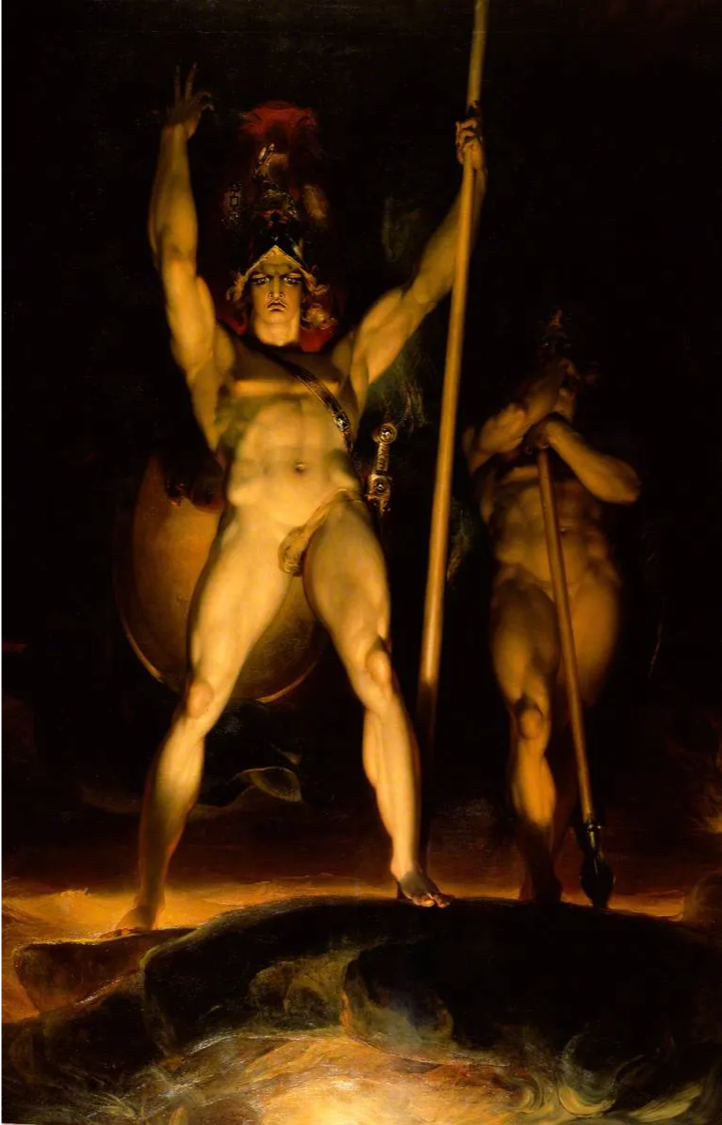
But not as Elias had ever seen in any museum book.
This version felt… alive.
The reds deeper.
The shadows breathing.
The central figure’s outstretched arm almost luminous with command.
Seraphine watched his reaction carefully.
“The families keep the true copies,” she murmured.
“What you’ve seen in public are… reductions. Sanitized. Tamed.”
Her hand drifted from his wrist to the back of his neck, warm, steady, claiming.
“This,” she said, nodding toward the painting, “is the architecture’s oldest image of leadership.”
Elias stared at it — the arching wings, the summoned ranks in the smoke, the figure at the apex directing legions not with force, but with certainty.
“It looks like mythology,” he said quietly.
“No,” Seraphine whispered, stepping around him, her body brushing air near his chest.
“It is a mirror.”
She circled him slowly, her fingers grazing the line of his shoulder — a priestess guiding a novice around an altar.
“Power,” she said, “has always been a religion. And every religion requires a veil.”
Her steps stopped behind him.
He felt her hands rest lightly on his upper arms, her breath at the base of his skull.
“The veil we use?”
Her voice was soft.
Almost amused.
“Whichever creed the public already trusts. The louder the piety… the deeper the concealment.”
She moved to his side again, lifting his chin with a single finger, the gesture precise and unhurried.
“There is the public faith,” she said, “and there is the one that actually governs.”
Her eyes shone in the dim gold light.
“Our faith is older than scripture. Older than states. Older than names.”
A pause.
“It is the faith of will, Elias. Of hierarchy. Of summoning what others fear to command.”
She gestured subtly toward the painting.
“Look at him,” she murmured.
“Look at what he calls. Not monsters — followers.”
Her fingertip traced the air just beneath Elias’s jaw.
“You are not being prepared to participate,” she said.
“You are being prepared to serve.”
His breath caught.
She smiled softly.
“Yes,” she whispered.
“That is the correct fear.”
Then she stepped closer — close enough that he felt the shift of air between them — and spoke with the quiet certainty of someone reciting liturgy.
“In every generation, a handful are chosen to carry the deeper doctrine.
To learn the rituals behind the rituals.
To serve the master behind the architecture.”
Her thumb brushed his lower lip — not with affection, but as if marking him for recognition.
“You will enter rooms where performance becomes sacrament.
Where influence becomes offering.
Where power is fed — not symbolically, but structurally.”
Her eyes darkened, pupils widening.
“And I,” she said, voice like silk sliding across stone,
“am preparing you for those rooms.”
She stepped back — barely — letting the gravity break only enough for him to breathe again.
“Elias,” she murmured,
“you must understand what you are becoming.”
Another curtain fell inside the room, revealing a second painting — a modern reinterpretation of Lawrence’s work, abstracted into ink-wash geometry and gold sigils.
It glowed faintly.
“The families do not worship a demon,” she said.
“They worship structure. Hierarchy. Command.”
She placed his hand over his own chest, guiding his heartbeat with her palm.
“And those who serve that structure must know whom it echoes.”
Her lips nearly brushed the air near his cheek.
“Now,” she whispered, “you may begin the First Assignment.”
CHAPTER XI — THE DARK DOCTRINE
XI. The Dark Doctrine — “Where Power Learns Its Worshippers”
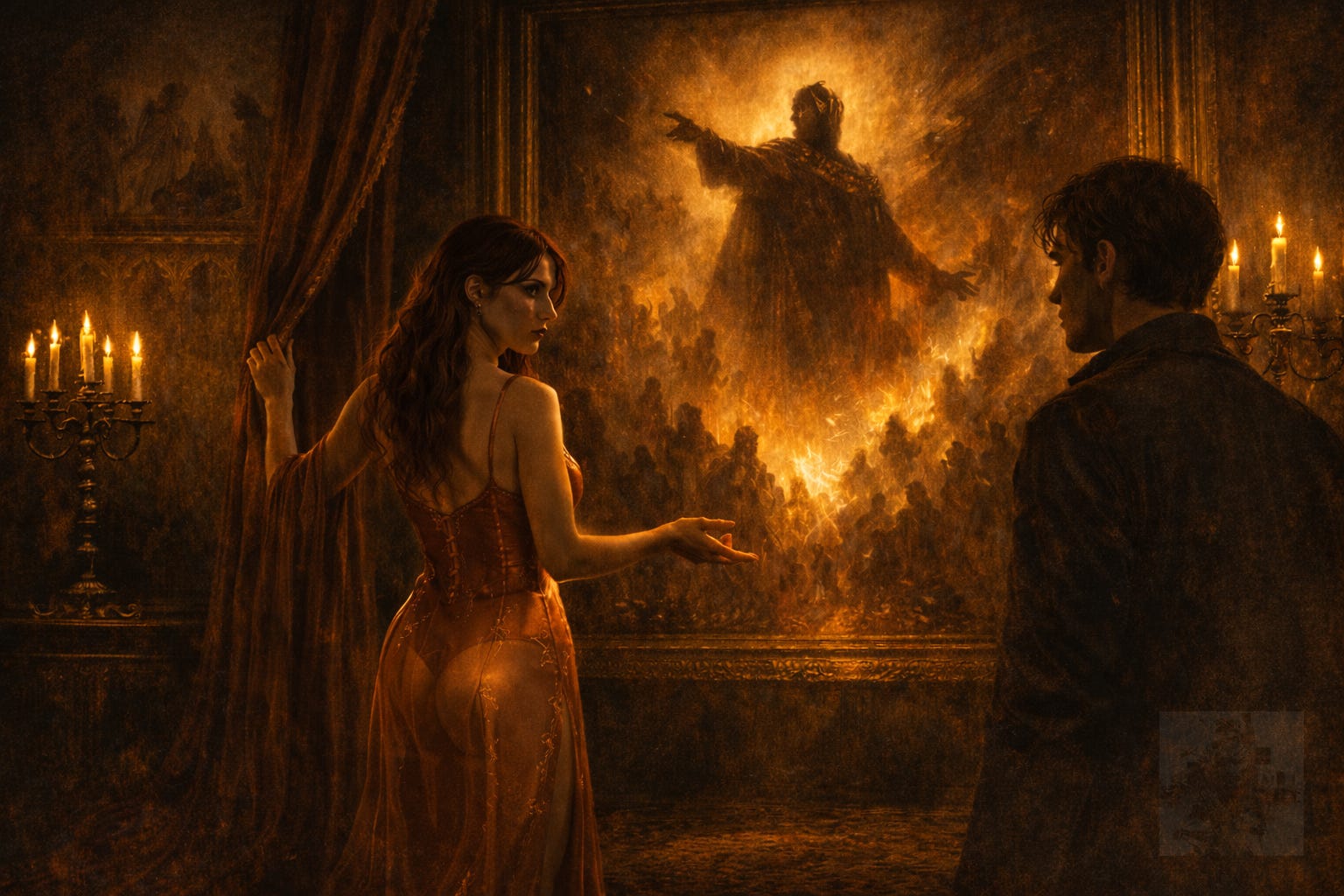
The painting was only the threshold.
Seraphine let the velvet curtain fall back over Thomas Lawrence’s Satan Summoning His Legions, its afterimage still burning in Elias’s mind — the outstretched arm, the luminous command, the ranks forming in smoke like a bureaucracy in hell.
A soft click echoed behind him.
She had locked the door.
Not with a key.
With intention.
“Come,” she murmured.
Silk shifted as she moved deeper into the chamber. Elias followed, each step sinking into a carpet that felt older than the house.
The room opened into an annex — another chamber concealed behind architecture designed for secrecy, for rites whispered down generations that no ledger ever named.
Candelabras flickered along the walls, their flames reflecting in panels of blackened gold. Above them ran a frieze: faded murals of winged figures bending toward enthroned shapes somewhere in the liminal space between authority and appetite.
Seraphine touched the mural lightly.
“This house,” she said, “has endured four revolutions, three purges, and a war that burned half this city.”
Her fingers traced the outlines of the kneeling figures.
“And yet the murals remain. Because the Doctrine predates every government that ever tried to hide it.”
She turned toward him, eyes luminous in the half-light.
“You were never meant for politics, Elias. You were meant for devotion.”
I. The Descent Room — The Initiation of Appetites

She walked ahead, guiding him into the heart of the annex. The air grew warmer, perfumed with incense and something metallic beneath it — something ceremonial, unsettling, unplaceable.
At the center stood a long, low table of polished obsidian. Upon it:
masks of lacquered bone-white
a chalice etched with geometric sigils
a folded garment of dark velvet
and a single open book, handwritten in a script that curved like smoke rising from forbidden candles.
Elias stepped closer. The pages seemed to shiver with movement.
Seraphine’s palm settled softly at the back of his neck.
“This,” she whispered, “is the Descent Room.”
“Descent into what?” he asked.
Her smile was almost tender.
“Into honesty.”
She gestured toward the masks.
“In public, power wears virtue. In private, it wears appetite.”
She lifted one of the bone-white masks — elegant, faceless, with eye slits sharp as judicial cuts.
“The Gatherings you’ve heard rumored?”
She placed the mask into his hands.
“They are not parties. They are revelations.”
Elias ran a thumb along the lacquer, feeling its coldness seep into his skin.
Seraphine leaned close.
“At Ferrières, the families perfected the practice of influence through ritual. Masks allowed them to speak the truths they couldn’t utter in daylight. What they consumed, whom they touched, what alliances they forged — all done without identity, without consequence.”
“Ferrières was only one of the houses shaped by the Lethran Dominion — the empire that first codified appetite into hierarchy and secrecy into governance.”
She held his jaw, angling his face toward her.
“The Doctrine teaches that transparency is for peasants. Masks are for rulers.”
Seraphine touched the open page, tracing a sigil that curved around an illustration of two figures — one elevated, one submitting.
“This posture,” she whispered, “is the first gate.”
She turned from the table and moved toward the ceremonial bed draped in maroon cloth, the place where initiates were taught the Doctrine not through words, but through geometry.
“Come, Elias. You will understand once you are positioned.”
II. The Doctrine of Masks — A Baroque Theology of Secrecy
They rose from the ritual bed without speaking, the air still trembling from the geometry she had pressed into him. Seraphine led him deeper into the chamber’s inner ring, where the architecture shifted from initiation to instruction.
She crossed to a cabinet and opened it.
Inside hung robes — deep burgundy, wine-dark, threaded with gold so thin it caught the candlelight like veins of fire.
She withdrew one and draped it across her forearm.
“The families learned long ago:
shame is a leash.
Taboo is a gate.
Hidden appetite is a currency.”
Her tone remained soft, almost devotional.
“At the Gatherings, there is no pretense. Only truth. A truth expressed through… appetite.”
She did not specify the nature of that appetite.
She didn’t have to.
The weight of history — of Ferrières, of whispered scandals, of unnamed rites in unnamed houses — filled the room like a pulse.
“And behind the respectable religion they espouse publicly,” she continued, “lies the Doctrine that actually binds them.”

She dipped her fingers into a basin of scented water, then touched his throat lightly, anointing him.
“They need the public’s morality. But they worship something else entirely.”
III. The Doctrine of Consumption — The Ritual of Claiming
Seraphine lifted the chalice.
Inside was a deep red liquid, thick enough to cling to the rim.
“This,” she said, “is not wine. It is a declaration.”
She held it near his lips.
“The Doctrine teaches:
To consume is to claim.
To feast is to bind.
To swallow a secret is to own the soul that confessed it.”
She did not make him drink.
She made him understand.

“The symbolic feasts you will see are not meals,” she whispered.
“They are contracts.”
She set the chalice down.
“In the Doctrine, consumption is metaphysics.
One does not eat.
One absorbs.”
Her fingers slid down his wrist, the gesture gentle, proprietary.
“Nothing in the Gatherings is literal.
Everything is binding.”
IV. The Master Without a Face — The Cosmology of Power
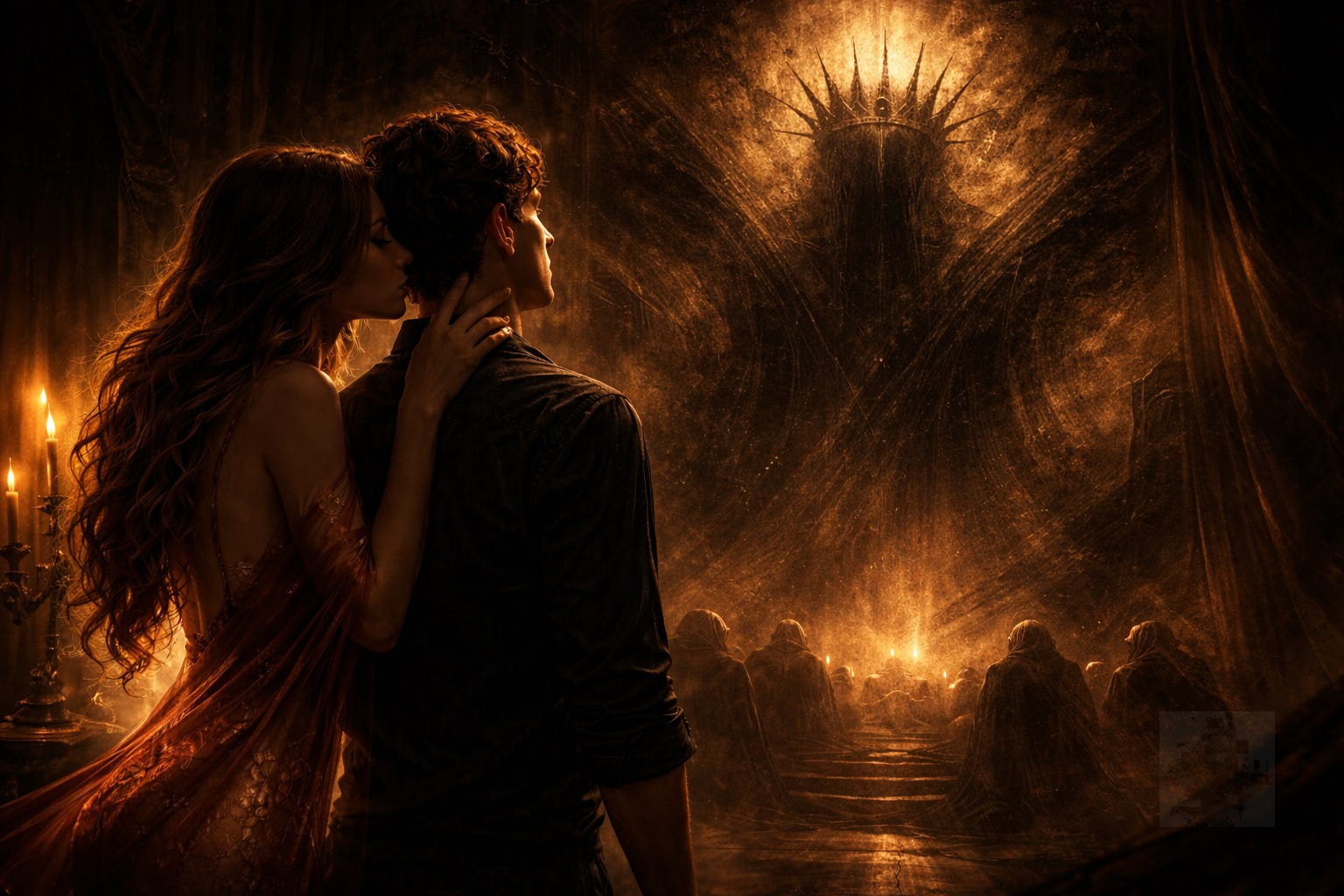
She led him to the final curtain.
When she pulled it aside, Elias expected another painting.
What he saw instead made the breath still in his chest.
A mural, nearly floor to ceiling.
A figure painted in ink-black strokes that seemed to move when not observed directly.
No face. No features. Only a crown of geometric blades where eyes should be.
Around the figure knelt dozens of supplicants — masked, robed, heads bowed.
Seraphine’s voice softened into reverence.
“This is The Master Without a Face.”
She placed her hand over his heart.
“Not a demon. Not a god. Not a man.”
Her thumb traced the notch of his collarbone.
“It is a lineage wearing a single mask… a continuity made flesh. The architecture itself.”
Elias stared at the faceless figure.
“What does the Master want?”
Seraphine exhaled a warm breath against his cheek.
“Obedience. Secrets. Desire. Confession. Appetite.”
Her lips nearly grazed his skin.
“And those who serve Him must know the doctrine behind every gesture, every feast, every whispered truth.”
V. The Rite of Witness — His First True Instruction

She turned him toward the table.
Placed the mask over his face.
The world dimmed.
Then she lifted his chin with one fingertip.
“For your First Assignment,” she whispered,
“you will not speak.”
Her hand slid to the base of his skull, steadying him.
“You will not judge.”
Her forehead touched his.
“You will not flinch.”
She placed a folded card into his hand — a name, a date, a location.
“Tonight,” she murmured, voice soft as velvet draped over a blade,
“you will learn to serve the Master.”
She stepped back.
“Next,” she said, her smile a quiet, devastating prophecy,
“you will learn to be seen by Him.”
CHAPTER XII — THE SILENT MATRIARCHY
XII. The Silent Matriarchy — Where Lineage Speaks Without Voices

The descent did not begin with steps.
It began with breath.
A door behind the ritual chamber opened to a corridor that did not appear in the house’s architecture—one of those impossible spaces that felt older than floor plans, older than intention.
Seraphine led Elias forward with a hand resting lightly against the small of his back, Her touch did not push; it arranged. As though she were placing him into a shape the architecture had already chosen.
The air deepened. Sound thinned. Even the dust seemed to slow. Nothing in the corridor was still — yet every movement belonged to something other than him.
“You will feel watched,” Seraphine whispered.
Her breath warmed the curve beneath his ear.
“That is the purpose.”
Elias felt the same sensation he once felt in Hawthorne’s study — the awareness of being observed by something that had no eyes.
She brought him into the first chamber.
I. THE RITE OF DIMMING — Where the World Stops Speaking

Masked figures stood in a half-circle, each robe woven with gold-thread sigils that flickered like the pulse of something sleeping beneath the fabric.
Elias entered the center.
Seraphine placed a bone-white mask into his hands.
“Raise it only when I say.”
She stepped forward. One masked figure extinguished a candle. Then another. Each step she took pulled light out of the room as if her movement itself consumed flame.
Her voice emerged soft, measured, sinking into his bloodstream:
“In silence, truth survives.
In stillness, power wakes.
In dimming, the initiate becomes unseen.”
As she approached, Elias felt something impossible: the room itself listening.
Walls tightening.
Architecture bending its attention toward him.
Then the circle moved.
Not forward—inward.
One masked figure brushed past his shoulder, the fabric grazing his skin with ritual precision.
Another stepped behind him, two fingers skimming the line of his spine—testing for flinch.
A third inhaled near his throat, measuring the tremor of his pulse through breath alone.
These were not caresses.
They were examinations.
The first grooming of the body.
A test of instinct.
A test of stillness when surrounded by presence.
Then Seraphine reached up and adjusted the angle of his jaw, the same way she once adjusted his posture in the Deep Rooms: a small correction that felt like ownership.
When she finally lifted the mask to his face — but did not lower it — the world thinned to a single dim thread of perception.
His breath stalled.
His pulse slowed.
A new kind of seeing entered him, a seeing without eyes.
It was not darkness that entered him.
It was instruction.
A spine of secrecy grew behind his real one.
He was being reshaped.
Not taught.
Reshaped.
II. THE TEST OF OBEDIENCE — The Voice Inside the Noise
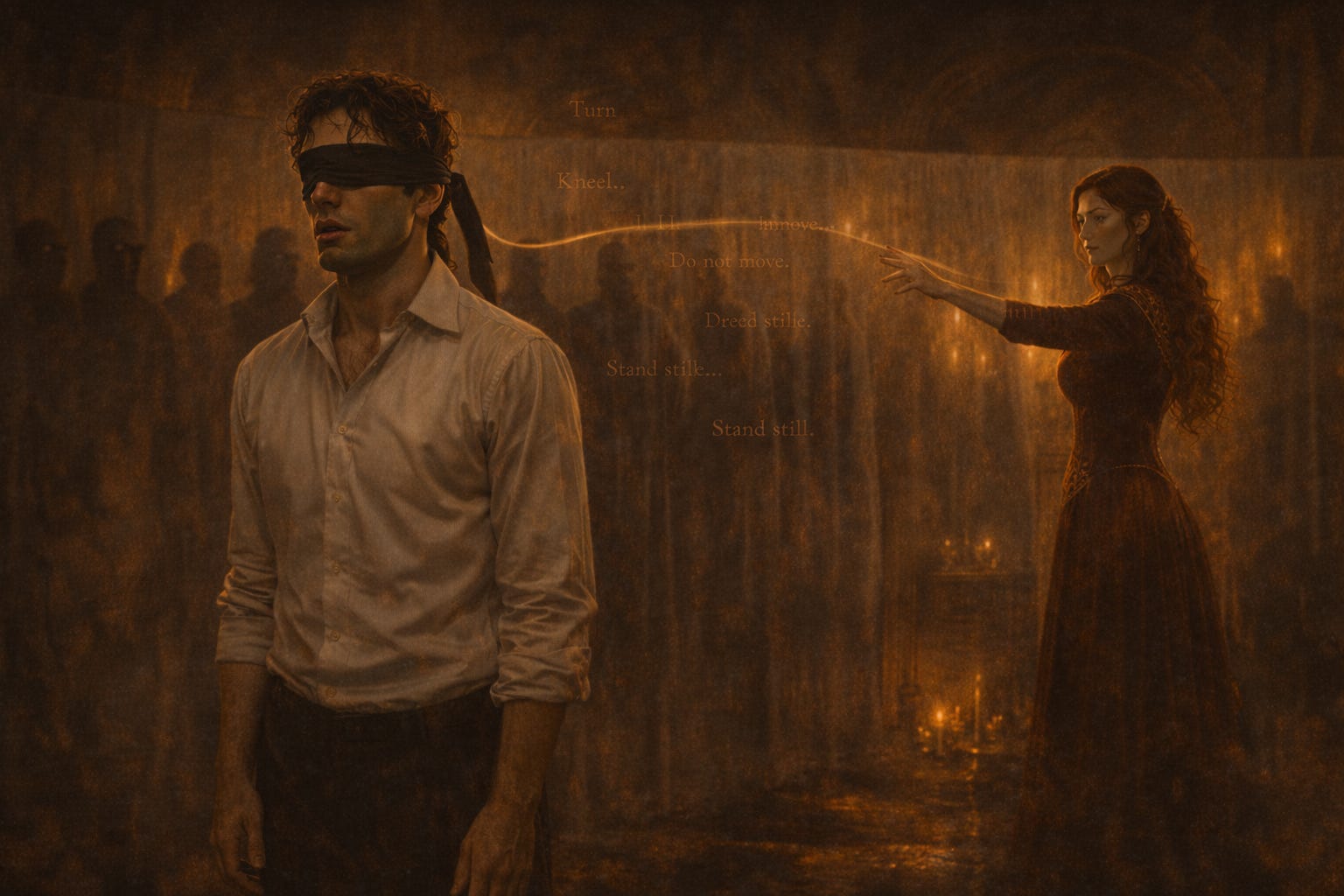
Seraphine blindfolded him.
Her fingers brushed the bone at the base of his skull—
not a caress, but an alignment.
A gentle anchoring.
A claim.
“Listen.”
The masked figures began to circle.
Their robes whispered in uneven intervals, breaking the air into fragments.
Footsteps looped around him in deliberate dissonance — never predictable, never steady.
The sound field bent, as though the architecture itself was being tuned against him.
Then the commands began.
“Turn.”
“Do not move.”
“Kneel.”
“Walk.”
“Stand still.”
“Breathe.”
“Stop breathing.”
Voices from every direction, overlapping at strange angles: a chorus designed not to instruct, but to disassemble.
Elias felt panic rise like a creature waking inside his ribs, clawing upward, seeking escape.
The noise thickened.
Sense dissolved.
The world became a storm of authority without meaning.
And then, A single note cut through it.
“Elias.”
Seraphine’s voice.
Soft, but unmistakable.
Like a hand closing around the spine of his name.
The others fell away.
Not silenced, but erased.
He felt the room hinge toward her, as though even the architecture deferred.
“Forward,” she said.
He stepped.
The panic retreated.
The storm receded.
Every other command collapsed into insignificance.
This was grooming in its first form:
psychological binding.
The forging of loyalty to a singular voice inside a world built to confuse.
A test to see whether he could be shaped into a node: a receiver of instruction, not from the world, but from one chosen source.
When Seraphine removed the blindfold, nothing in the room had changed, and yet everything had.
The figures stood exactly where they had been.
The candles burned at the same height.
The air was still.
But the hierarchy had shifted.
He felt smaller. He felt selected. He felt, unmistakably, claimed.
III. THE CIRCLE OF NODES — The Grooming of Scale

Seraphine led him through an archway that had not existed a moment earlier.
He did not hear it open.
It simply appeared — as though the architecture had decided he was now permitted to see more of itself.
Darkness swallowed them first.
A darkness without depth, without air, without direction.
The kind that makes a person forget whether they occupy space at all.
Then — light surfaced.
Not abruptly.
Not kindly.
It awakened like a memory returning at the wrong time: slow, intimate, disquieting.
Thousands of faint glowing points flickered to life across the walls.
They pulsed — softly, irregularly — like fireflies caught inside stone that could still remember warmth.
Elias blinked and understood.
He was not looking at lights.
He was looking at a map.
A map of the architecture.
Of the lineage.
The lineage, Seraphine had once hinted, traced its origin to the Lethran Dominion — the ancient state where obedience was not taught but carved into the marrow of generations.
Of every operative connected to whatever system had been grooming him long before he recognized the shape of its hands.
Each point—the nodes—dimmed and brightened as if responding to distant commands.
Then thin lines of gold thread emerged between them, one by one, revealing a nervous system older than anything built with human hands.
The lines trembled faintly, as though messages moved through them.
He stepped closer.
One node flickered.
His.
The wall recognized him.
A vibration moved through his body — not heat, not cold, but something that seemed to bypass sensation entirely, reaching instead for whatever part of a person decides whether to resist or submit.
Seraphine’s voice arrived at his shoulder, quiet enough that it felt like a correction rather than speech.
“You are one,” she murmured, “because we need many.”
Her breath brushed his cheek, but the room was the thing speaking.
“You are not chosen for who you are,” she said.
“You are chosen for what you can be made to carry.”
His knees weakened.
His lungs tightened, as if adjusting themselves to a pressure they had always known but never acknowledged.
The map pulsed again. His node brightened.
The network absorbed him — not ceremonially, not dramatically, but with the calm inevitability of water closing over a stone.
He understood.
This was not recruitment.
Recruitment requires choice.
This was absorption.
He was being scaled, folded into a structure vast enough to erase the idea of an individual entirely.
The architecture did not ask him to join it.
It simply began using him.
IV. THE SENATE OF MASKED ELDERS — The Grooming of the Body
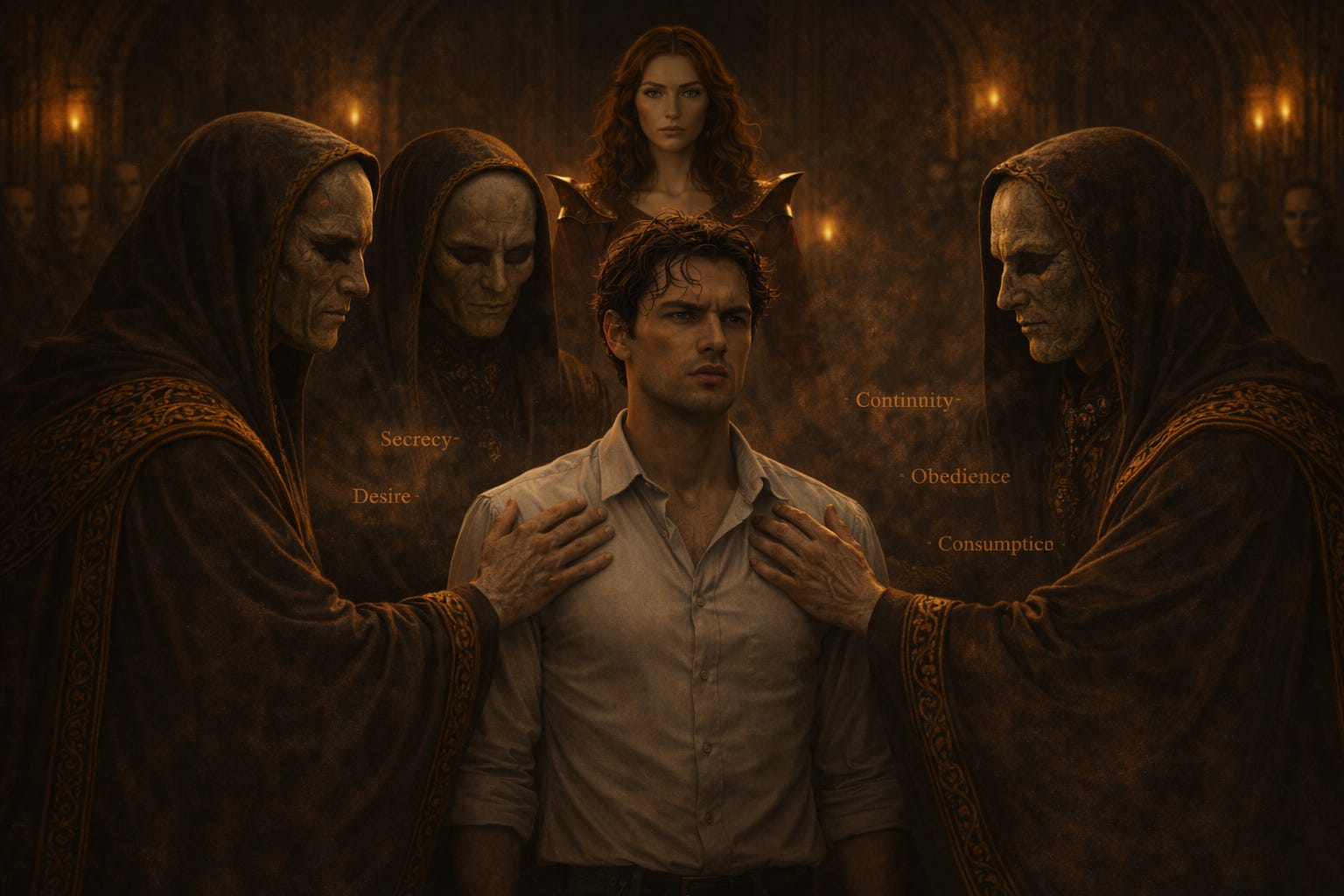
They emerged from the shadows without sound.
Tall.
Ritual-robed.
Masks older than memory.
One by one, they approached him.
Each placed a palm against his chest over his heart and whispered a single word.
“Secrecy.”
“Debt.”
“Ruin.”
“Continuity.”
“Obedience.”
“Desire.”
“Consumption.”
Their touch was not caressing.
It was assessing.
Measuring restraint.
Measuring pulse.
Measuring the tremor beneath his skin.
This was grooming in its second form:
the testing of instinct.
He was surrounded by bodies.
Heat.
Breath.
Proximity.
Pressure.
Desire and fear interlaced.
The masked elders watched for flinches, micro-reactions, the stir of appetite or weakness. His spine stiffened; his pulse regulated; his composure held.
Seraphine exhaled softly, as if confirming he was ready.
V. THE LADY — The Grooming of Hierarchy
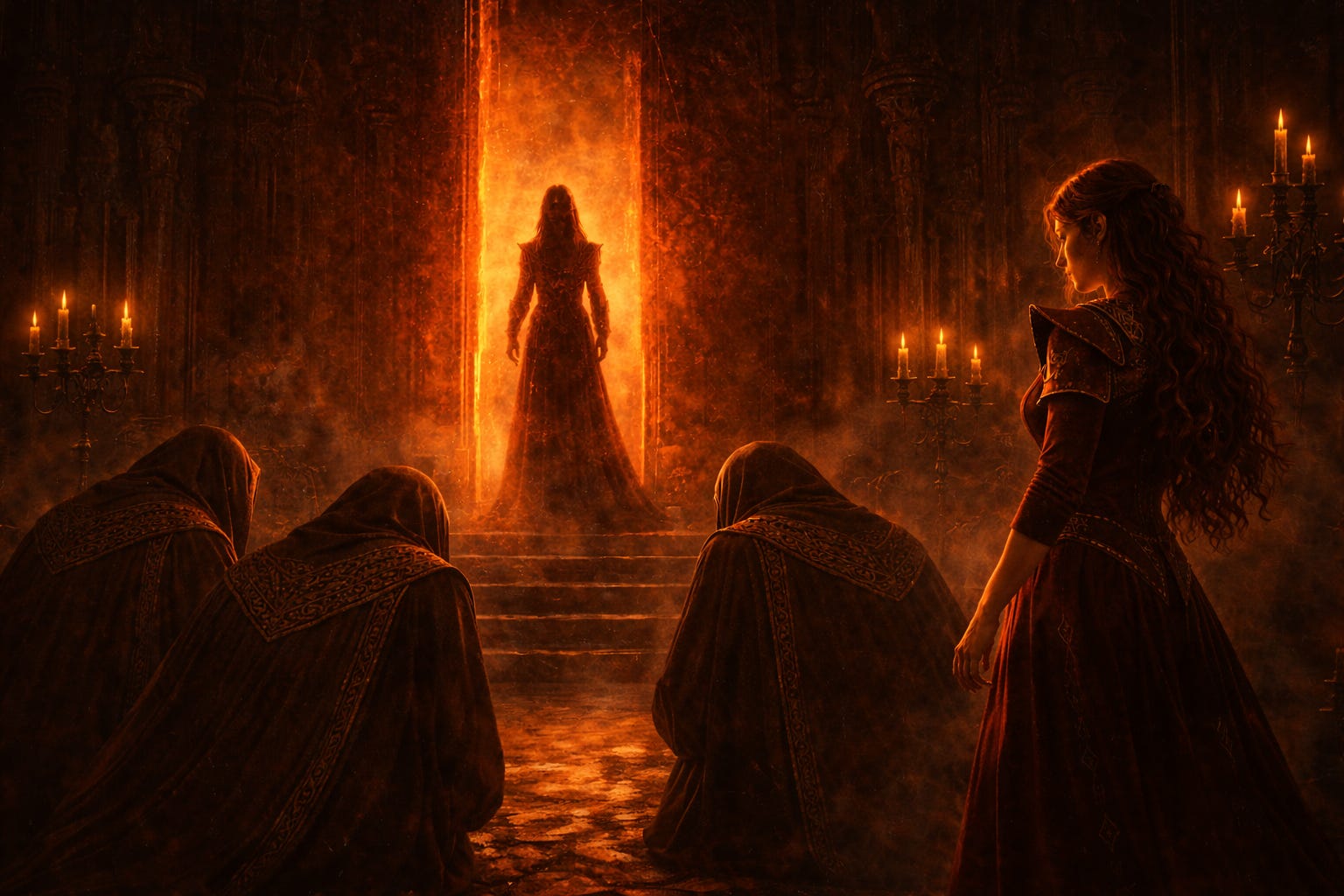
The chamber did not brighten.
It contracted.
Walls inhaled.
Shadows pulled inward.
The air thinned into a single, trembling thread.
Then, a red-gold fracture of light split open at the far end of the ritual hall.
Not illumination.
Revelation.
Seraphine stepped aside — not retreating, but assuming her place in a hierarchy older than her bones.
Her posture lowered by a fraction so small only the architecture caught it.
The elders froze mid-breath.
The node-map dimmed as if bowing.
And She entered.
Tall.
Precise.
Elemental.
The Lady.
If Seraphine was fire shaped into instruction,
The Lady was time shaped into sovereignty.
Elias felt something behind his ribs kneel even though his body did not move.
The elders lowered themselves — instinct, not ritual.
Seraphine bowed her head — the first and only time.
The Lady approached him without footfall, as if her arrival was simply the room remembering her shape.
She touched the edge of his mask with gloved fingers.
Not tender.
Not cold.
A gesture of reading — like tracing the grooves of a relic carved by fate.
“You have been shaped,” she murmured,
her voice resonant with centuries.
“Now you will be used.”
It was not cruelty.
It was geometry.
Seraphine exhaled behind him — one soft, shuddering release of breath, as though acknowledging that the moment she had prepared him for had finally arrived.
“Walk with her,” Seraphine whispered.
But her voice was not instruction this time.
It was farewell pressed into breath.
He stepped forward.
His pulse belonged to architecture now.
His fate belonged to lineage.
His life became a node claimed by something vast.
Behind him, Seraphine spoke one last time — not as a woman, not as his shaper, but as a witness carved into the spine of history:
“Elias…
to be seen by Him
is to be rewritten
into something that remembers you differently
than the world ever will.”
The Lady turned.
The door closed behind them like a cosmic verdict.
And the architecture accepted its newest instrument.

CHAPTER XVI — THE OMINOUS THREAD
“Where Fiction Shows Its Original Blueprint”
I. The Pivot — The Reveal the Architecture Was Always Leading You Toward

There is a moment, in any engineered narrative, when the shapes you thought you recognized dissolve, and the outline beneath them finally appears.
This is that moment.
Because Elias was never meant to be Jeffrey Epstein.
Seraphine was never meant to be Ghislaine Maxwell.
Hawthorne was never meant to be only Donald Barr.
These were the training wheels.
You were nudged to think:
This is Epstein’s origin story.
This is Maxwell in fog.
This is Donald Barr rewritten in allegory — the novelist who mapped the system before it existed.
But the architecture was never pointing toward Epstein.
It was pointing toward the force that produced him.
The hidden truth is this:
Jeffrey Epstein was not a mastermind — he was a Rothschild asset.
A node.
A replaceable unit in a lineage older than any intelligence service.
And in the files unsealed in 2026, Epstein finally said the quiet part out loud:
“I represent the Rothschilds.” — Jeffrey Epstein

That sentence is the Rosetta Stone of the architecture.
The system never elevated men like Epstein.
It selected them. It shaped them. It deployed them.
The architecture does not build individuals.
It builds prototypes.
Epstein was not the blueprint.
He was the output.
The one truth the architecture hides until the final possible moment is this:
The blueprint did not begin with Epstein.
Its earliest shape can be traced to 1917, when Arthur Balfour promised Palestine to Lord Rothschild — a private letter that midwifed the modern State of Israel and the intelligence networks that would later cultivate men like Epstein.
From that moment forward, public governments and private dynasties stopped being separate entities.
They became one architecture.
Every corridor you walked in this story,
every ritual,
every grooming room,
every silent benefactor,
was shaped to echo the oldest and wealthiest private intelligence dynasty on earth.
Epstein’s admission wasn’t a confession.
It was confirmation that we can stop calling this “conspiracy”
and start analyzing the lineage that actually governs the machinery.
This is not a footnote.
It is the axis of the entire system.
The Barrs were functionaries.
The intelligence services were instruments.
The politicians were tenants.
The Rothschilds were the architecture.
Not one woman.
Not one branch.
Not one name on a letterhead.
A dynasty whose financial and political reach formed the ceiling of the entire system.
And this is why The Lady exists.
Inspired by Lady Lynn Forester de Rothschild — yes — but not limited to her.
She represents the function:
the emissary,
the velvet bridge between the dynasty and the men it selects.
The shape the architecture uses when it needs to whisper, not command.
And the role is real:
Epstein’s own lawyer said it outright: Dershowitz didn’t meet Epstein through chance:
he was connected to him by Lady Lynn Forester de Rothschild, the same woman who linked Epstein to presidents, prime ministers, scientists, and billionaires.
She was not an assistant.
She was the liaison.
The conduit.
The human interface between a centuries-old financial empire and the disposable node it chose to deploy.
She symbolizes the machinery above Epstein, the piece of the dynasty the world was allowed to glimpse.
Just as The Lady was to Elias.
Because the truth is this:
Epstein was not the monster.
Epstein was a position.
A role.
A node.
A replaceable instrument within a multi-generational apparatus of financial leverage, sexual blackmail, political conditioning, and transnational intelligence exchange.
And Elias?
Elias is not Epstein.
Elias is the type the system produces again and again and again:
The boy whose silence is useful.
The young man whose rise makes no sense.
The vessel whose value lies in what powerful people do near him.
Epstein was only one iteration.
Elias is the next silhouette the system would sculpt.
And the recognition that arrives too late for most people is this:
Elias is your neighbor.
Elias is the philanthropist you admire.
Elias is the man who buys a bagel from you every morning.
He already exists around you, not as a single man, but as a category.
A template.
A doctrine in human form.
The Architecture was never hiding a monster.
It was hiding multiples, teaching you to overlook them, to shake their hands, to thank them for their generosity.
This story exists for one reason:
to hand you the pattern
so you finally recognize the face wearing it.
II. Lineage Notes — The Real Infrastructure Beneath the Fiction
This is not the full map — only the connecting thread.
The next investigation will expose each lineage in full.
1. THE ROTHSCHILD APEX — The True Origin Point
Where the architecture begins — long before Epstein, Barr, or Maxwell enter the frame. Where the blueprint stops resembling conspiracy and starts revealing continuity.
A private intelligence apparatus older than most nation-states.
Financial sovereignty beyond governments, borders, or oversight.
Epstein’s newly unsealed declaration: “I represent the Rothschilds.”
The ~$160B network Epstein referenced — the infrastructure above all intermediaries.
The dynasty that functions as the real Dominion behind every subordinate domain.
Ariane de Rothschild, chairwoman of Edmond de Rothschild Group, personally thanked Epstein for the “thrilling hunt.”
She oversees a multibillion-dollar financial empire servicing global elites, royalty, and political power centers.
This is the apex the rest of the system bends toward.

2. DONALD BARR — The Recruiter
Where the pipeline begins — the first architect of Epstein’s trajectory, long before Epstein had wealth, access, or protection.
Dalton headmaster who hired Epstein with zero credentials, granting him entry into elite homes and circles he had no organic path into.
Space Relations reads as Barr’s encoded doctrine: minors groomed for servitude, aristocratic domination, sexualized obedience, and the engineering of silence.
The novel frames exploitation as “civilization” — the same ideological scaffolding Epstein was later shaped to operate within.
Hawthorne isn’t just a character; he is a prototype — a fictional rehearsal of the mechanism Barr enacted in reality.
This is where Rothschild Space Relations: The Grand Architecture truly roots itself:
my investigative decryption of Barr’s coded universe, revealing the real machinery he embedded in fiction and how that doctrine later manifested through Epstein’s network.

3. BILL BARR — The Custodian

Where the machinery shifts from recruitment to protection — and finally, to disposal.
CIA-linked — confirmed directly by Epstein himself.
Oversaw Iran-Contra damage control, refining the doctrine of engineered deniability.
Oversaw the prison, the cameras, the “suicide,” and the narrative surrounding Epstein’s 2019 death.
Declared the surveillance tapes “missing” — the 2026 Epstein Files prove the tapes existed.
Issued a DOJ statement announcing Epstein’s death before Epstein was found dead.
Now defending Pam Bondi, reinforcing the same protection system his family helped construct.


THE ATLANTIC SAYS “NO GRAND CONSPIRACY.”

Before the headlines reassured you that nothing was wrong, its author’s patron was tanning beside the woman who made Epstein possible. This is how the architecture edits reality.
The Atlantic just published a piece insisting that
“the Epstein files reveal no grand conspiracy.”
But its owner, Laurene Powell Jobs, appears in photos as a friend of Ghislaine Maxwell — Epstein’s handler.
When media claims “there was nothing there,” check who stands behind the microphone.
And the woman they forgot to mention in their story…
is the woman who held the entire network together.
4. GHISLAINE MAXWELL — The Handler
Where the machinery shifts from grooming to global liaison. The bridge between the dynasty and the asset.
Where aristocratic lineage intersects directly with intelligence command.
Daughter of Robert Maxwell — the media baron whose empire doubled as a Mossad-linked influence network. His death at sea, officially “mysterious,” closed investigations that would have exposed his intelligence ties.
Served as Epstein’s operational partner: recruitment, placement, and psychological conditioning of assets.
Functioned as the social and diplomatic interface — the conduit through which Epstein accessed presidents, prime ministers, billionaires, scientists.
Maintained direct ties to the Rothschild social sphere, attending their private gatherings and operating inside the same elite ecosystems that shaped the architecture.
Her role was not romantic. It was strategic: the Handler, trained from childhood within a media–intelligence dynasty.
Maxwell was not the origin point. She was the administrator of the node. A replaceable emissary in a structure far older than her.
5. PAM BONDI — The Gatekeeper

Where the cover-up moves from inheritance to enforcement.
Held the 2008 Epstein prosecution files in her office and took no action.
Oversaw the same office that helped justify the “sweetheart deal” through intelligence claims.
Pam Bondi as Attorney General in 2026, she refused to release the Epstein Files, lied about what they contained and even after Congress forced disclosure through the bipartisan Epstein Files Transparency Act (Massie & Khanna), she still withheld critical documents from the public.
Publicly insisted “there was no blackmail” — even after:
Howard Lutnick, Epstein’s next-door neighbor and Trump’s Commerce Secretary, confirmed Epstein ran blackmail operation,
NYT identified Miriam Adelson as the custodian of those recordings,
and the new files proved the blackmail evidence existed.
Now defended in public by Bill Barr, completing the lineage loop.
Pam Bondi didn’t break the machine — she became its gatekeeper.
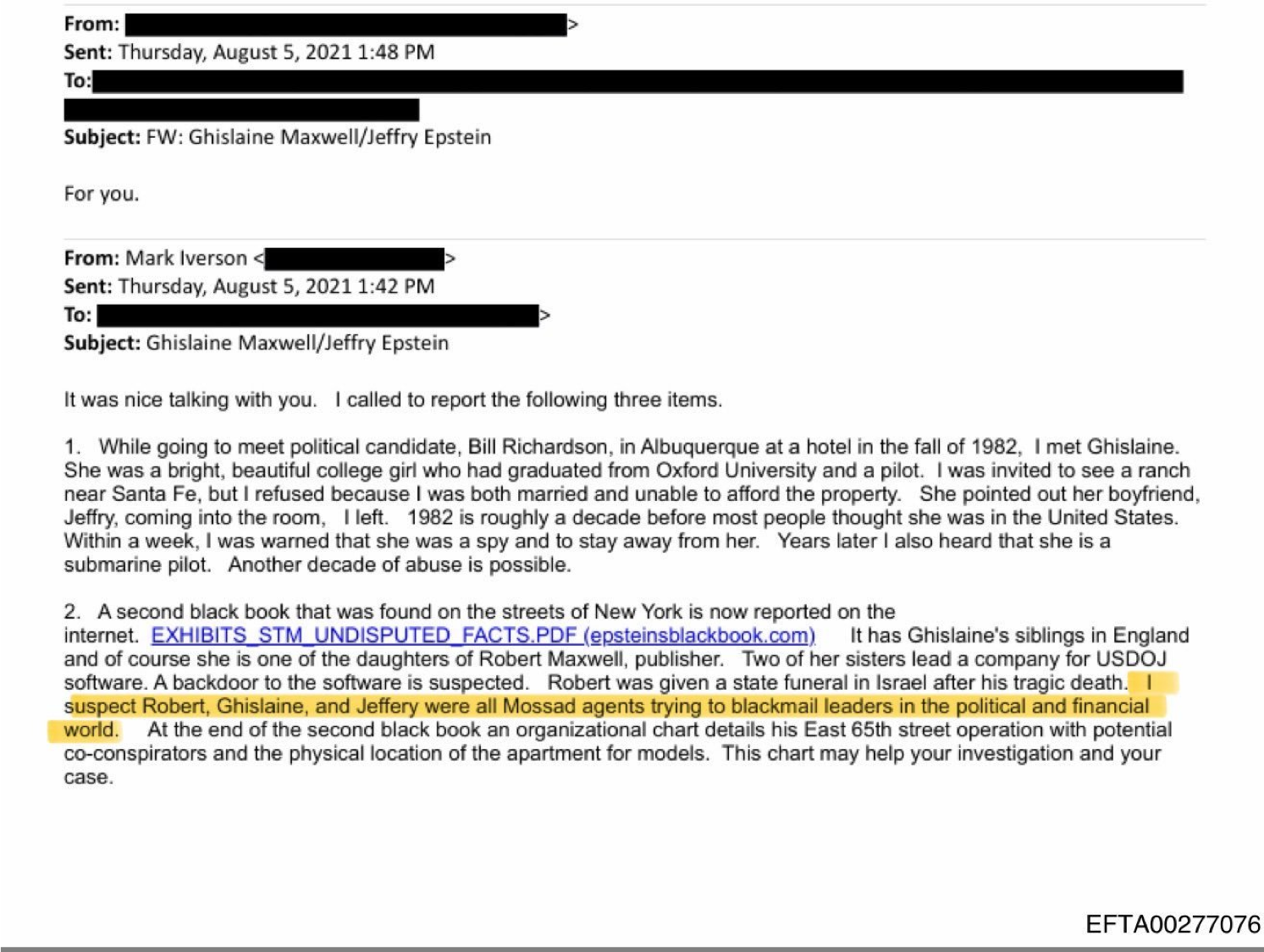
6. ALEX ACOSTA — The Messenger

Where the system stops pretending and finally speaks its own name.
Told investigators he was instructed to “leave it alone… he belonged to intelligence.”
Justified Epstein’s 2008 sweetheart deal as a “national security” matter — the first open admission of a protected asset.
Accepted a non-prosecution agreement that shielded co-conspirators and buried victims’ testimony.
Became the conduit through which the intelligence excuse entered the official record.
Acosta wasn’t the architect. He was the message the architecture sent.
7. INTELLIGENCE NETWORK — The Operational Arm
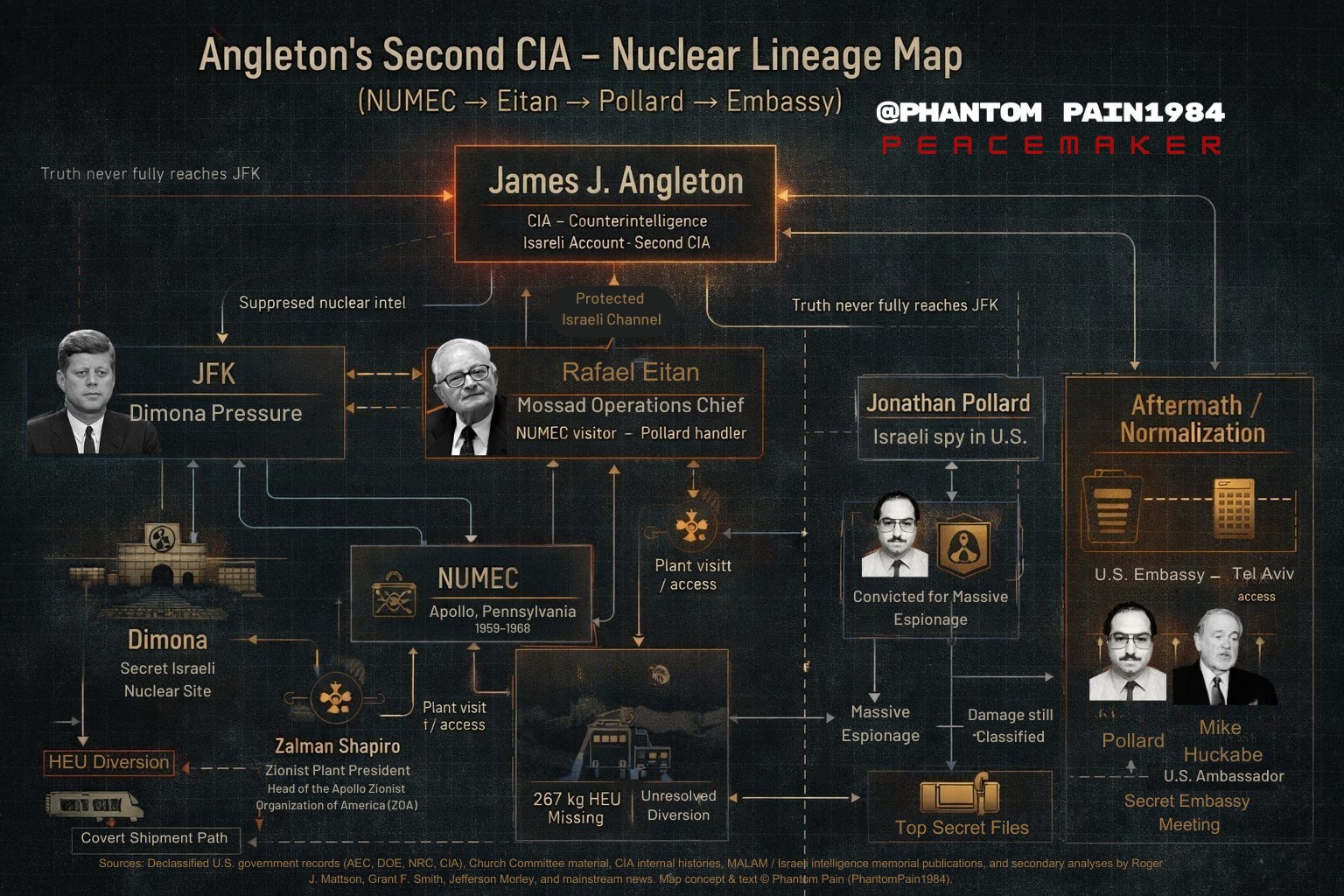
Where the architecture transitions from theory into machinery.
Angleton’s Israeli channel — the original backdoor pipeline.
The Kirya — Israel’s central military–intelligence command complex.
Glilot — the Israeli SIGINT/intelligence hub tied to foreign liaison operations.
Mossad liaison frameworks built to manage assets like Epstein.
Dulles-era doctrine — the system crafted by the CIA director JFK dismissed, only to be reinstalled by LBJ to find out who assassinated JFK.
LBJ’s integration with emerging Likud networks.
The network didn’t protect Epstein because he was powerful.
He was powerful because the network protected him.

THE VEIL BEFORE THE ARCHITECTURE

What you have read was never meant to be a story.
It was the veil before the architecture.
A rehearsal in shadows, where fiction was the only safe language the machinery could use to speak without speaking.
Every character was a contour of someone who lived.
Every ritual, a softened copy of a documented method.
Every corridor, borrowed from a real address.
This work was the orientation chamber.
The next will be the archives.
Because the systems that shape history do not introduce themselves.
They surface in fractures:
a letter dated one day too early,
a dynasty woven through every chapter,
a node whose successor is chosen long before his fall.
The Dominion leaves signatures, not confessions.
Now that you know the pattern, the architecture can no longer hide behind the men it manufactures.
The next work opens the sealed rooms.
Once those rooms are open, you’ll understand the oldest truth in power:
Structures endure.
Faces are temporary.
And while you were reading, while the world went on around you…
The next one has already stepped into the crowd.
SUPPORT NOTE
The Phantom Directive remains free by principle.
Public awareness should never be gated.
But the investigative work behind these reports — the research, verification, analysis, and the fight against coordinated suppression — is only possible because readers choose to support it.
If you can become a paid subscriber, it directly strengthens this project.
If you prefer a one-time gesture, you can buy me a coffee:
buymeacoffee.com/phantompain1984
If neither is possible, sharing this investigation is still an act of resistance.
Either way, participation matters.
The system depends on silence; this project depends on refusal.
— Phantom Pain
Postscript — Reality Moves in Parallel
As this piece goes to publication, Ghislaine Maxwell has invoked the Fifth before Congress and Bill Clinton has been called to testify.
The nodes may fall, but the architecture remains intact.
Before the architecture was built, its blueprint was written.
The novel Space Relations isn’t fiction — it’s the prototype.
If you want to understand the system that produced Epstein,
you start where the dynasty first spoke in code.
Read it. Decode it. Download it.
Perhaps the style was jaw touching and architecturally incredulous, but it painted a perfect picture of the Epstein role and the centuries old control grid.
Prosecuting the guilty, auditing the FED, and making AIPAC register as a foreign agent are all good places for us to start the clean up.
#NCSWIC
Now that was awesome 👏 I read it in parts throughout the day starting this morning . Put it down a while contemplated it for a while. Did some other stuff then came back and started reading again ..just finished.⭐️⭐️⭐️⭐️⭐️